1.14 Pension note: the 2025 actuarial gain is put down to higher discount rates, but the disclosed UK rate did not change
UK Company A · a UK-listed medical technology group · Regulator-style question
In brief
The note says the [amount] actuarial gain on the obligation [wording masked] 2025. The only discount rate disclosed, for the UK Plan, is [n]% in both 2025 and 2024, while the UK inflation assumptions fell. The sentence is the 2024 report's wording with the year and amount changed; in 2024 the UK rate had risen from [n]%.
The evidence, as filed
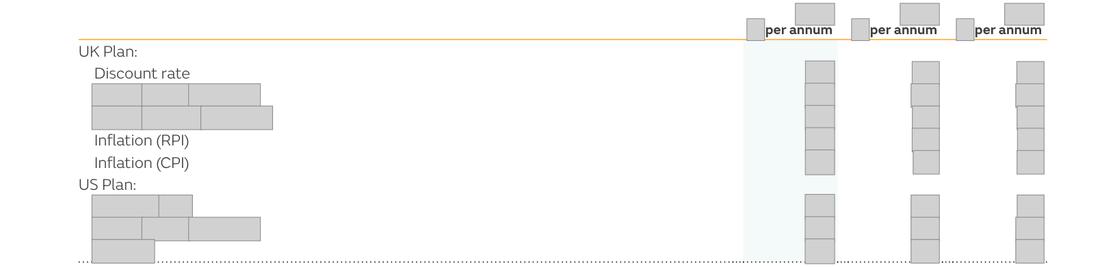

Further pages withheld to protect the company’s identity (two): Annual Report 2025, page 255; Annual Report 2024, page 235. Their wording or layout could lead back to the company even with names and figures masked; the evidence list below records what each page shows.
Names, figures, dates, logos and any wording that could be searched back to the company are boxed out in grey; the point is highlighted in yellow.
What the report shows, and what the rule requires
| What the annual report shows | What the rule requires |
|---|---|
| What the annual report shows p.255: '[wording masked] [amount] [wording masked] 2025 compared to 2024'. p.257: UK discount rate [n] (2024: [n]); RPI [n] (2024: [n]). | What the rule requires An explanation that matches the disclosed assumptions, for example the lower UK inflation assumptions and, if it is so, higher discount rates in the other plans, with the plans named. |
The rule
IAS 19 Employee Benefits, paragraph 141(c)
Version relied on: UK-adopted international accounting standards (UK Endorsement Board), as in force for financial years beginning in or after January 2025
Remeasurements of a defined benefit liability or asset must be broken down, showing separately the return on plan assets and the actuarial gains and losses from demographic and financial assumption changes.
Why it applies here: on the UK figures the gain owes at least as much to lower inflation as to discount rates; whether discount rates in the other plans (obligation [amount]) rose enough to make them the main driver cannot be seen from the note.
Why it matters
Readers are given a cause for the 2025 remeasurement that the disclosed assumptions do not show, which weakens the explanation of a movement through other comprehensive income.
Exposure
Narrative accuracy only; no recognised amount is affected.
Our workings
Note 18.2 attributes the [amount] gain on the obligation to higher discount rates. Note 18.5 shows the UK Plan discount rate at [n]% at both year ends, and UK RPI falling from [n]% to [n]%. The gain from financial assumptions in the reconciliation is [amount]. The 2024 report used the same sentence when the UK rate rose from [n]% to [n]%.
on the UK inflation sensitivity (a [n] basis point fall reduces the obligation by [amount]), the [n] point fall in RPI accounts for about [amount], roughly half of the [amount] financial-assumption gain.
| Step | Figure |
|---|---|
| UK discount rate 2025 / 2024 / 2023 (as printed) | [n]% / [n]% / [n]%; change in 2025: [n] - [n] = [n] |
| UK RPI fall | [n] - [n] = [n] |
| UK inflation effect on the obligation (sensitivity scaled) | [n] x [n] / [n] = [n] |
| Share of the financial-assumption gain | [n] / [n] = 50% |
Management’s best defence, and our reply
The company can say the sentence refers to the group as a whole, and that discount rates for the other plans, whose obligation is [amount] and whose assumptions are not disclosed, may have risen in 2025 enough to make discount rates the main driver. It can add that the remeasurement is small and correctly recognised in other comprehensive income. However, the only rate the note discloses did not move, the UK inflation fall alone explains about half of the financial-assumption gain, and the sentence is last year's wording with the figures changed, so a reader cannot check the explanation; because the other-plans argument may be right, the point is put as a question.
The fix
- Replace the sentence with the actual drivers, for example: '[wording masked] [amount] mainly reflects lower UK inflation assumptions [and higher discount rates in the other plans]'.
Question for the company
Which plans' discount rates rose in 2025, and how much of the [amount] gain from financial assumptions came from discount rates rather than from the lower UK inflation assumptions?
Evidence relied on
| # | What it shows | Type | Where |
|---|---|---|---|
| 1 | the note attributes the 2025 gain to higher discount rates | Document | Annual Report 2025, page 255 |
| 2 | financial-assumption gain [amount] in 2025 | Document | Annual Report 2025, page 255 |
| 3 | other plans' obligation [amount], whose assumptions are not disclosed | Document | Annual Report 2025, page 255 |
| 4 | UK Plan discount rate unchanged at [n]% (2023: [n]%) | Document | Annual Report 2025, page 257 |
| 5 | UK RPI assumption fell from [n]% to [n]% | Document | Annual Report 2025, page 257 |
| 6 | UK inflation sensitivity: a [n] basis point fall reduces the obligation by [amount] | Document | Annual Report 2025, page 258 |
| 7 | the same sentence in the 2024 report, when the UK rate rose from [n]% to [n]% | Document | Annual Report 2024, page 235 |
Prepared by Pramanex from the company’s published annual reports, without the company’s involvement, to show how an annual report review reads. The company is not named, and nothing on this page is a statement about any identifiable company. Observations are not an audit, review or other assurance engagement, and not legal advice. A regulator-style question is a question, not a conclusion.
Want this on your own annual report, before it is published?
Start with three free findings on your latest published annual report, or talk to us about a fixed-fee pre-publication review.
Your annual report will be in draft before the year-end audit.
Have it read before it is published.
Under NDA, with our reviewer on your insider list under UK MAR.