2.11 The 2025 bonus trading-margin outcome depends on excluding a [amount] inventory charge, and the report does not say the Remuneration Committee considered it
UK Company A · a UK-listed medical technology group · Regulator-style question
In brief
Trading profit margin carried 35% of the 2025 annual bonus and paid out at 165% of target on an actual margin of [n]%. That margin excludes, as 'Legal and other', a [amount] excess and obsolescence charge on inventory that the income statement records in cost of goods sold. With the charge included the margin is [n]%, below the [n]% threshold. The Remuneration Committee says it applied no discretion, but the report does not say whether it considered the exclusion.
The evidence, as filed
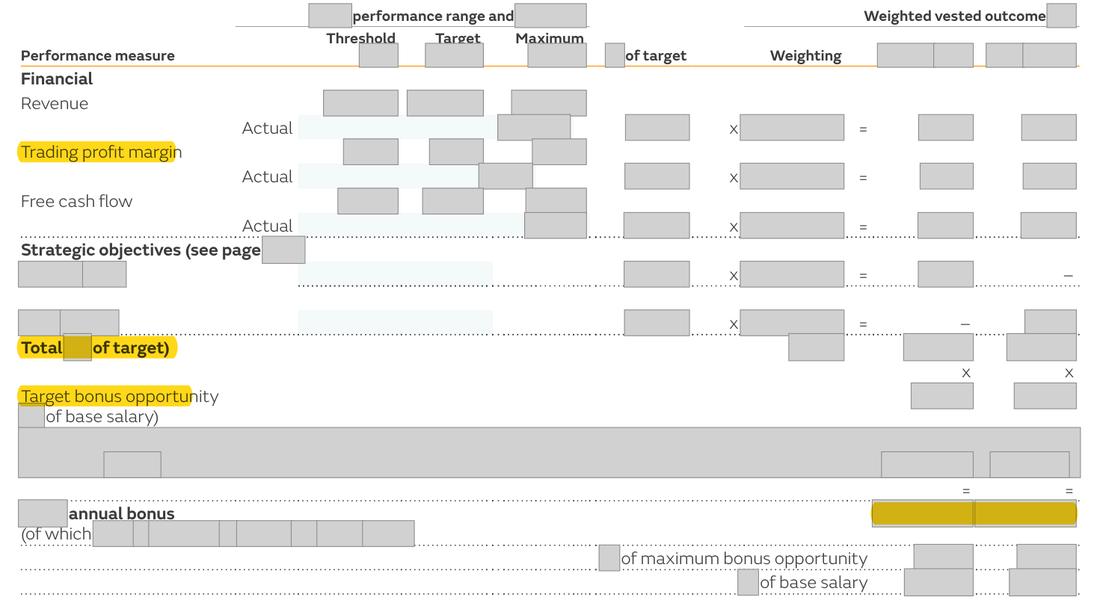
Further pages withheld to protect the company’s identity (four): Annual Report 2025, page 288; Annual Report 2025, page 236; Annual Report 2025, page 16; Annual Report 2025, page 151. Their wording or layout could lead back to the company even with names and figures masked; the evidence list below records what each page shows.
Names, figures, dates, logos and any wording that could be searched back to the company are boxed out in grey; the point is highlighted in yellow.
What the report shows, and what the rule requires
| What the annual report shows | What the rule requires |
|---|---|
| What the annual report shows Bonus: trading profit margin actual [n]% (threshold [n]%, target [n]%, maximum [n]%), [n]% of target, [n]% weighted. Trading profit of [amount] excludes, as 'Legal and other', the [amount] inventory charge (2024: $nil). Remuneration Committee: no discretion applied; no statement on the inventory charge. | What the rule requires A statement in the Directors' Remuneration Report whether the Committee considered that the margin outturn excludes the [amount] charge, with its reasoning, given that the item decides whether the measure pays 165% of target or nothing. |
What we checked: Bonus table and Remuneration Committee Chair's letter; trading profit reconciliation and its 'Legal and other' footnote; inventory note; KPI page; Audit Committee significant matters; prior-year reconciliation.
The rule
SI 2008/410 Schedule 8 para 12(3)(c)-(d)
Version relied on: Large and Medium-sized Companies and Groups (Accounts and Reports) Regulations 2008 (SI 2008/410), in force from April 2008, as amended (the directors’ remuneration report Schedule 8 as substituted from October 2013); revised text, legislation.gov.uk
for each performance measure, details of actual performance relative to the targets set and measured over the relevant reporting period, and the resulting level of award; and ... where any discretion has been exercised in respect of the award, particulars must be given of how the discretion was exercised
UK Corporate Governance Code 2024, Provision 41
Version relied on: UK Corporate Governance Code, FRC, January 2024; applies to financial years beginning in or after January 2025 (Provision 29 from January 2026)
There should be a description of the work of the remuneration committee in the annual report, including: ... to what extent discretion has been applied to remuneration outcomes and the reasons why.
ESMA Guidelines on Alternative Performance Measures, para 25
Version relied on: ESMA Guidelines on Alternative Performance Measures, ESMA/2015/1415, published October 2015, applying from July 2016; the FCA expects UK issuers to continue to apply them after EU exit
For example items that affected past periods and will affect future periods will rarely be considered as non-recurring, infrequent or unusual
Why it applies here: the exclusion is within the company's definition of trading profit (items that materially affect profitability on a one-off basis) and the Audit Committee approves non-trading items; but inventory obsolescence provisioning is a recurring part of the [business unit] business, the rationalisation is expected to continue 'over time', and the item decides the bonus outcome on this measure.
Why it matters
If the Committee did not consider the exclusion, shareholders voting on the remuneration report cannot judge whether [n] percentage points of each executive director's bonus outcome reflects trading performance or the classification of a single inventory charge.
Exposure
No legal breach is asserted; the risk is a shareholder or proxy-adviser challenge at the 2026 AGM vote on the remuneration report.
Our workings
the 2025 Annual Incentive Plan weights trading profit margin at 35%, with a threshold of [n]%, target [n]% and maximum [n]%; the actual of [n]% scored [n]% of target, [n]% of the weighted outcome for each executive director. The trading profit reconciliation adds back 'Legal and other', which its footnote says mainly relates to a [amount] [wording masked] from portfolio simplification; the inventory note records the [amount] (2024: $[wording masked] Chair's letter states that no discretion was exercised to adjust formulaic outcomes. The KPI page attributes the [n]bps rise in trading margin to operating leverage and efficiency savings and does not mention the exclusion.
with the charge included, trading profit is [n] - [n] = [n] and the margin [n] / [n] = [n]%, below the [n]% threshold, so that measure would pay nothing; on the report's own percentages the bonus would fall by about [amount] for the Chief Executive Officer and [amount] for the Chief Financial Officer (bonus targets are measured at constant currency, so this is approximate).
Whether the Committee considered it is a matter only the Committee can answer.
| Step | Computation | Result |
|---|---|---|
| Trading profit including the inventory charge ([currency]m) | [n] - [n] = [n] | [n] |
| Trading margin including the charge | [n] / [n] = [n]% | below [n]% threshold |
| Reported trading margin | [n] / [n] = [n]% | printed [n]% (constant currency) |
| CEO bonus outcome without this measure | [n]% - [n]% = 107% | 107% of target |
| CEO bonus recomputed ($) | [n] x [n] x [n] = [n] | [n] - [n] = [n] |
| CFO bonus outcome without this measure | [n]% - [n]% = 104% | 104% of target |
| CFO bonus recomputed ($) | [n] x [n] x [n] = [n] | [n] - [n] = [n] |
| Total ([currency]m) | [n] + [n] = [n] | [n] |
Management’s best defence, and our reply
The Committee would say the bonus measure is trading profit margin as defined in the published non-IFRS policy, which has always excluded items that materially affect profitability on a one-off basis, and that the Audit Committee approved this specific item within the non-trading items policy. The charge arises from a strategic decision under the new RISE strategy to discontinue product ranges, akin to restructuring, which the targets set early in 2025 did not anticipate, and the long-term incentive measure (adjusted return on invested capital) bears the charge in full. The report itself states (page 152) that the trading profit margin [wording masked] is the non-IFRS measure reconciled on pages 285 to 292, and in 2023 a [amount] inventory write-off on the discontinued Engage products went to the same 'legal and other' line (page 220), so the treatment is consistent. That is a tenable position. However, inventory obsolescence provisioning is a normal recurring cost of the [business unit] business, the rationalisation is expected to continue over time, and the classification alone moves this measure from no payout to 165% of target; Schedule 8 and the Code ask the report to explain such judgements, and it does not.
The fix
- Add to the Annual Incentive Plan section: 'Trading profit margin for bonus purposes excludes the [amount] excess and obsolescence charge recognised on the inventory portfolio rationalisation. The Committee considered this exclusion because ... and concluded that ...', with the outcome had the charge been included.
Question for the company
When it confirmed the 2025 Annual Incentive Plan outcome, did the Remuneration Committee consider that the trading profit margin of [n]% excludes the [amount] excess and obsolescence charge, which on the report's own figures would place the measure below its [n]% threshold; what was its reasoning, and will the 2026 report explain it?
Evidence relied on
| # | What it shows | Type | Where |
|---|---|---|---|
| 1 | Bonus measure: threshold, target, maximum, actual and score | Document | Annual Report 2025, page 177 |
| 2 | Total bonus outcome for each executive director | Document | Annual Report 2025, page 177 |
| 3 | Base salaries used for the bonus | Document | Annual Report 2025, page 177 |
| 4 | 2025 bonuses paid | Document | Annual Report 2025, page 177 |
| 5 | Weighted outcome of the trading margin measure | Document | Annual Report 2025, page 177 |
| 6 | Target bonus as % of salary | Document | Annual Report 2025, page 177 |
| 7 | 2025 trading profit | Document | Annual Report 2025, page 288 |
| 8 | The inventory charge is excluded from trading profit as 'Legal and other' | Document | Annual Report 2025, page 288 |
| 9 | The charge sits in cost of goods sold in the IFRS income statement and is new in 2025 | Document | Annual Report 2025, page 236 |
| 10 | Revenue used for the margin | Document | Annual Report 2025, page 16 |
| 11 | KPI page explains the margin rise without mentioning the excluded charge | Document | Annual Report 2025, page 16 |
| 12 | No discretion applied; no reference to the inventory charge | Document | Annual Report 2025, page 151 |
Prepared by Pramanex from the company’s published annual reports, without the company’s involvement, to show how an annual report review reads. The company is not named, and nothing on this page is a statement about any identifiable company. Observations are not an audit, review or other assurance engagement, and not legal advice. A regulator-style question is a question, not a conclusion.
Want this on your own annual report, before it is published?
Start with three free findings on your latest published annual report, or talk to us about a fixed-fee pre-publication review.
Your annual report will be in draft before the year-end audit.
Have it read before it is published.
Under NDA, with our reviewer on your insider list under UK MAR.