1.13 The share-based payment note gives three numbers and none of the option movements or fair value information that IFRS 2 requires
UK Company A · a UK-listed medical technology group · Regulator-style question
In brief
Note 22.1 gives the plan names, the number of options [wording masked], the maximum number of shares under the long-term incentive plans and the charge of [amount] (2024: [amount]). It does not give the reconciliation of options (granted, forfeited, exercised, expired, exercisable) with weighted average exercise prices, the remaining contractual life, or how the fair value of the awards granted in the year was measured. The 2024 note is the same. The parent company also relies on these group disclosures to take its own FRS 101 exemption from IFRS 2, an exemption that is available only if the group gives equivalent disclosures.
The evidence, as filed
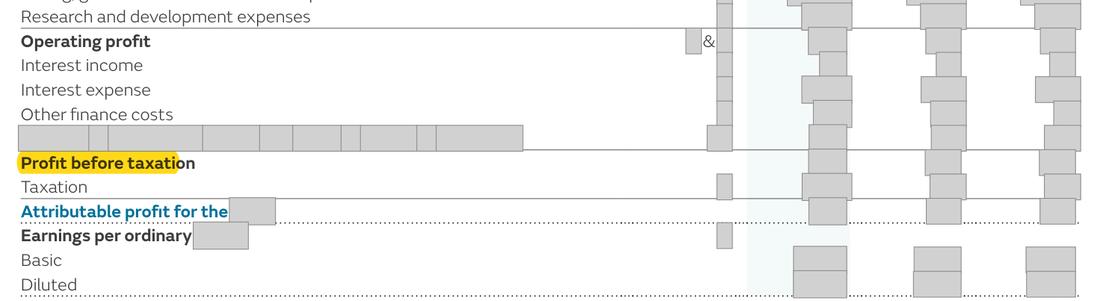
Further pages withheld to protect the company’s identity (three): Annual Report 2025, page 265; Annual Report 2024, page 247; Annual Report 2025, page 268. Their wording or layout could lead back to the company even with names and figures masked; the evidence list below records what each page shows.
Names, figures, dates, logos and any wording that could be searched back to the company are boxed out in grey; the point is highlighted in yellow.
What the report shows, and what the rule requires
| What the annual report shows | What the rule requires |
|---|---|
| What the annual report shows The share-based payment note (both years): plan names; options outstanding at year end ([n]; 2024: [n]) [wording masked] of [n] to [n] pence (2024: [n] to [n] pence); the maximum shares under the long-term incentive plans; expense of [amount] (2024: [amount]). No movement table, no weighted average exercise prices, no exercisable number, no remaining contractual life, no grant-date fair values, no model inputs. The Company note says the consolidated statements include the equivalent disclosures. | What the rule requires A description of each plan's terms (vesting conditions, maximum term, settlement); the option reconciliation from opening to closing with weighted average exercise prices, including the number exercisable; the weighted average share price at exercise; the weighted average remaining contractual life; for options and for share awards granted in the year, the number and weighted average fair value and how it was measured (model, inputs, volatility basis, market conditions). |
What we checked: Read Note 22.1 of both years against IFRS 2 paragraphs 44-52; searched the whole 2025 report for the missing items; read Company Note 1 against FRS 101 paragraph 8(a).
The rule
IFRS 2 Share-based Payment, paragraph 45(b)
Version relied on: UK-adopted international accounting standards (UK Endorsement Board), as in force for financial years beginning in or after January 2025
The accounts must give the number and weighted average exercise price of share options in each movement category for the year.
IFRS 2 Share-based Payment, paragraph 47(a)
Version relied on: UK-adopted international accounting standards (UK Endorsement Board), as in force for financial years beginning in or after January 2025
For options granted in the year, the accounts must give their weighted average fair value at the measurement date and explain how that fair value was measured.
FRS 101 Reduced Disclosure Framework, paragraph 8(a)
Version relied on: FRS 101 / FRS 102, FRC, as amended and in force for the financial year reviewed
A qualifying subsidiary or parent may take the reduced-disclosure exemptions only where equivalent disclosures appear in the group accounts that consolidate it.
Why it applies here: Most of the IFRS 2 paragraph 45(b)-(d) and 47 disclosure set is absent in both years; the parent's exemption condition is therefore not met.
Why it matters
Users cannot see how many options and awards were granted, exercised or lapsed, what they were worth at grant, or how a charge of over 5% of profit before tax was measured; the parent's FRS 101 exemption rests on a condition that is not met.
Exposure
If the FRC's Corporate Reporting Review raised it, the realistic outcome is a letter and an undertaking to give the full disclosures in the next report; revision of the accounts is unlikely for a disclosure-only gap.
Our workings
Note 22.1 of the 2025 report has four sentences: the plans operated, the options outstanding at [date] ([n]; 2024: [n]) [wording masked] [n] to [n] pence, the maximum [wording masked] long-term incentive plans and the income statement charge of [amount] (2024: [amount]). The 2024 note has the same four sentences. The Company's own Note 1 says it takes the FRS 101 exemption from IFRS 2 because the [wording masked].
the charge is [n]% of 2025 group profit before taxation and [n]% of 2024's (see workings).
IFRS 2 is built on three disclosure principles - the nature and extent of the arrangements (paragraph 44), how fair value was determined (paragraph 46) and the effect on profit or loss and financial position (paragraph 50) - each followed by a list the entity shall disclose 'at least'. The 'at least' wording makes paragraphs 45 and 47 a floor, not a menu. Against that floor the note gives only the closing number of options and the range of exercise prices (part of [n](b)(vi) and [n](d)) and the expense ([n](a)). The plans are not small: the charge is over 5% of profit before tax in 2025 and [n]% in 2024, and the long-term incentive awards (performance and restricted shares) are measured at grant-date fair value, which for awards with a relative total shareholder return (TSR) condition requires a model whose features paragraphs 47(a)(iii) and 47(b)(iii) require to be described. The grey area is IAS 1.31: a specific disclosure need not be given if the information is not material. That reading is not available here because the amounts are material by any measure used in this report and the omission covers the whole movement and valuation set, not one line. FRS 101 paragraph 8(a) lets an ultimate parent omit IFRS 2 paragraphs 45(b) and 46-52 from its separate statements only if equivalent disclosures are included in the consolidated financial statements; because the group note does not contain them, the condition the Company relies on is not met, and the parent's own statements also lack them.
| Item | Figure | Computation |
|---|---|---|
| 2025 charge as % of group profit before taxation | [n]% | [n] / [n] = [n]% |
| 2024 charge as % of group profit before taxation | [n]% | [n] / [n] = [n]% |
| Fall in options outstanding in 2025 (not analysed in the note) | [n] | [n] - [n] = [n] |
| Paragraph | Requirement | 2025 report | 2024 report |
|---|---|---|---|
| [n](a) | Terms of each arrangement: vesting, maximum term, settlement | Partial: plan names only | Partial: plan names only |
| [n](b)(i)-(v) | Options opening, granted, forfeited, exercised, expired with weighted average exercise prices | Absent | Absent |
| [n](b)(vi) | Options outstanding at end with weighted average exercise price | Partial: number only | Partial: number only |
| [n](b)(vii) | Options exercisable at end | Absent | Absent |
| [n](c) | Weighted average share price at exercise | Absent | Absent |
| [n](d) | Range of exercise prices and weighted average remaining contractual life | Partial: range only | Partial: range only |
| [n](a) | Options granted: weighted average fair value, model, inputs, volatility basis | Absent | Absent |
| [n](b) | Other equity instruments granted: number, weighted average fair value, how measured | Absent | Absent |
| [n](a) | Total expense | Given | Given |
Management’s best defence, and our reply
Management would say the plans are routine, the charge is fully expensed and the detailed movements of employee options are of little interest to investors, so IAS 1.31 allows the detail to be left out as immaterial information. They would add that directors' awards are set out in full in the remuneration report and that fuller tables appear in the US annual filing. However, IAS 1.31 relieves immaterial information, and a charge of [n]% of profit before tax ([n]% in 2024) is not immaterial; the remuneration report covers only directors, and a US filing does not satisfy the UK annual report. The Company's FRS 101 sentence also asserts that equivalent disclosures exist, which they do not.
The fix
- Expand Note 22.1 to give, for the Share Save plans, the option movement table with weighted average exercise prices, the exercisable number, the share price at exercise and the remaining contractual life; for the Global Share Plan awards, the number and weighted average fair value granted and the valuation model and inputs (including any TSR condition); keep the Company's exemption sentence only once these are in the group note.
Question for the company
How did the Board conclude that the IFRS 2 option movement table, the weighted average prices and the grant-date fair value information for awards granted in the year were not material, given a share-based payment charge of [amount] ([n]% of 2025 profit before taxation), and on what basis does the Company's own note state that the group accounts include the equivalent disclosures it relies on for its FRS 101 exemption?
Evidence relied on
| # | What it shows | Type | Where |
|---|---|---|---|
| 1 | The only option data given: closing numbers and a range of exercise prices | Document | Annual Report 2025, page 265 |
| 2 | The range of exercise prices, the only paragraph 45(d) item given | Document | Annual Report 2025, page 265 |
| 3 | The expense, the only paragraph 51 item given | Document | Annual Report 2025, page 265 |
| 4 | The Company relies on the group note for its IFRS 2 exemption | Document | Annual Report 2025, page 268 |
| 5 | Group profit before taxation used to size the charge | Document | Annual Report 2025, page 211 |
| 6 | The 2024 note gives the same limited data | Document | Annual Report 2024, page 247 |
| 7 | 2024 expense | Document | Annual Report 2024, page 247 |
| 8 | the 2024 note gives only the number outstanding and the exercise price range | Document | Annual Report 2024, page 247 |
| 9 | the 2024 expense the missing disclosures would explain | Document | Annual Report 2024, page 247 |
Absence check
- Document
- Annual Report 2025
- Where it would appear
- [n] Share-based payments
- What is missing
- the option reconciliation with weighted average exercise prices, options exercisable, share price at exercise, remaining contractual life, and the fair value and valuation inputs of options and awards granted in the year
- Pages looked at
- p.223, [n], 259-261, [n], 267-268 and the directors' remuneration report p.145-193
- Result
- 'forfeit' hits p.169, [n] and [n] only (individual directors' awards in the remuneration report, not the group option reconciliation); 'option pricing' hits p.265 and [n] only (the policy sentence naming models generically, with no model or inputs); 'volatility' hits p.80, [n] (market and financial risk narrative, none about share award valuation). 'weighted average exercise', 'exercisable', 'expected dividend' and 'lapsed' have no hits.
Absence check
- Document
- Annual Report 2024
- Where it would appear
- [n] Share-based payments
- What is missing
- the reconciliation of options outstanding with weighted average exercise prices, the weighted average share price at exercise, the weighted average remaining contractual life, and how the fair value of options and awards granted was measured
- Pages looked at
- Annual Report [amount].247 (Note 22.1), p.249 (parent company share-based payment policy), p.134-173 (directors' remuneration report)
- Result
- 'forfeited' hits only the directors' remuneration report (p.141, [n]: incentives one director forfeited at a former employer) and the dividend forfeiture rule in the articles; the other terms do not hit anywhere in the 2024 report; none of the hits is the option movement table or fair value information
Prepared by Pramanex from the company’s published annual reports, without the company’s involvement, to show how an annual report review reads. The company is not named, and nothing on this page is a statement about any identifiable company. Observations are not an audit, review or other assurance engagement, and not legal advice. A regulator-style question is a question, not a conclusion.
Want this on your own annual report, before it is published?
Start with three free findings on your latest published annual report, or talk to us about a fixed-fee pre-publication review.
Your annual report will be in draft before the year-end audit.
Have it read before it is published.
Under NDA, with our reviewer on your insider list under UK MAR.