1.09 Largest intangible assets: [name] is carried at [amount] in both years although its remaining amortisation period fell from 3 years to 2
UK Company A · a UK-listed medical technology group · Regulator-style question
In brief
Note 9 lists the Group's largest intangible assets with their carrying amount and remaining amortisation period, as International Accounting Standard (IAS) [n] requires for individually material intangibles. The [name] intangibles are shown at [amount] at the end of 2024 with 3 years left and at [amount] again at the end of 2025 with 2 years left, so the table implies no amortisation in 2025 on an asset that should lose about a third of its value each year. [name] moves the other way: it falls by [amount] against about [amount] of straight-line amortisation, with its remaining period barely changed.
The evidence, as filed
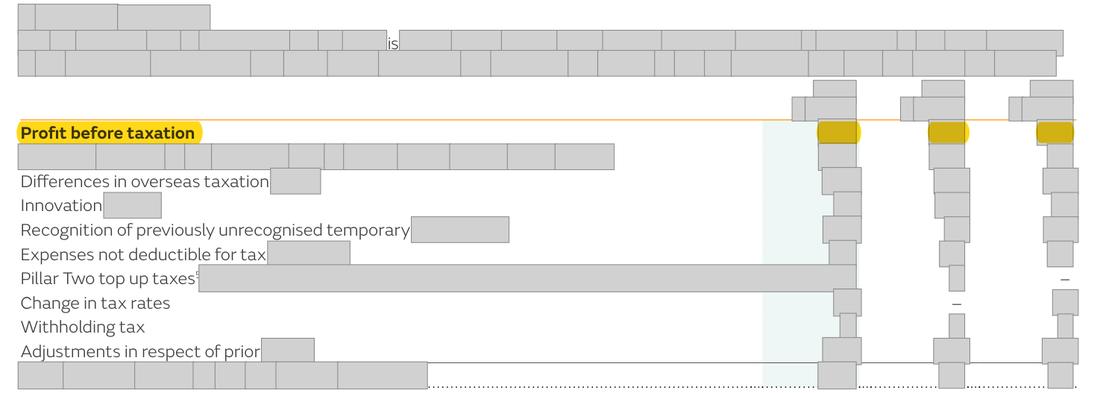
Further pages withheld to protect the company’s identity (three): Annual Report 2025, page 234; Annual Report 2024, page 216; Annual Report 2025, page 232. Their wording or layout could lead back to the company even with names and figures masked; the evidence list below records what each page shows.
Names, figures, dates, logos and any wording that could be searched back to the company are boxed out in grey; the point is highlighted in yellow.
What the report shows, and what the rule requires
| What the annual report shows | What the rule requires |
|---|---|
| What the annual report shows [name]: carrying value [n], remaining period 3 years (2024); [n], remaining period 2 years (2025). [name]: [n], 9 years (2024); [n], 8-9 years (2025). | What the rule requires Carrying amounts and remaining periods that move with the amortisation charged in the year, or an explanation (impairment, change of useful life, regrouping of assets) where they do not. |
The rule
IAS 38 Intangible Assets, paragraph 122(b)
Version relied on: UK-adopted international accounting standards (UK Endorsement Board), as in force for financial years beginning in or after January 2025
For any individual intangible asset that is material, the accounts must describe it and give its carrying amount and remaining amortisation period.
IAS 38 Intangible Assets, paragraph 97
Version relied on: UK-adopted international accounting standards (UK Endorsement Board), as in force for financial years beginning in or after January 2025
An intangible asset with a finite life must be amortised systematically over its useful life.
Why it applies here: one of the two years' tables, or the remaining periods, appears to be misstated or the assets have been regrouped without saying so; nothing in the report shows which, so the point is put as a question.
Why it matters
A reader cannot rely on the table to see when the Group's largest acquisition intangibles run off; if the [name] figure is right, an expected year of amortisation of about [amount] is missing from the charge, and if it is in error, an audited note required by IAS 38 needs correcting in one of the two years.
Exposure
None while the point is a question; the likely outcome is a corrected table or an explanation in the next report.
Our workings
the 2024 report lists [name] intangibles at a carrying value of [amount] with 3 years of amortisation remaining and [name] intangibles at [amount] with 9 years remaining. The 2025 report lists [name] at [amount] (technology [n], product-related [n], customer and distribution-related 3) with 2 years remaining and [name] at [amount] (technology [n], product-related [n]) with 8-9 years remaining. The policy says [wording masked] basis, and no acquisition, disposal or change of useful life is reported for these assets; the only 2025 impairment is [amount] on immaterial technology assets.
straight-line amortisation of [amount] over 3 years is [amount] a year, so [name] would be expected at about [amount] at the end of 2025, not [amount]; [name] at [amount] over 9 years is [amount] a year, which would leave more than the [amount] reported. Taken together the two lines fall by [amount] ([n] to [n]) against about [amount] of expected amortisation.
The amounts are audited note disclosures, and [amount] is [n]% of 2025 profit before taxation.
| Asset | 2024 carrying / period | Expected 2025 (straight line) | 2025 reported | Arithmetic |
|---|---|---|---|---|
| [name] | [n] / 3 years | [n] | [n] / 2 years | [n] / 3 = [n]; [n] - [n] = [n] |
| [name] | [n] / 9 years | [n] | [n] / 8-9 years | [n] / 9 = [n]; [n] - [n] = [n] |
| Two lines together | [n] | [n] | [n] | [n] + [n] = [n]; [n] + [n] = [n]; [n] + [n] = [n] |
| [name] gap against 2025 profit before taxation | [n] / [n] = [n]% | |||
| Fall in the two lines against expected amortisation | [n] | [n] | [n] - [n] = [n]; [n] + [n] = [n] |
Management’s best defence, and our reply
Management may say the table groups several assets per acquisition, with different remaining lives, so the carrying amount need not fall by a neat fraction each year, and that the 2025 table now splits each line by class, which may have moved assets between the acquisition lines. They may add that the table is illustrative and the movement table in Note 9 is the authoritative record. However, a group of finite-life assets with no additions cannot keep the same carrying amount over a year in which the stated remaining period falls by a year; the movement table shows no impairment or reassessment large enough to explain it, and IAS 38 requires the carrying amount and period of each material intangible to be right. No reading of the report reproduces both years, so the question is which figures are correct.
The fix
- Re-perform the table from the asset register for both years and either correct the [name] carrying amounts and periods or add a line explaining the movement (for example: '[name] intangibles include product rights whose useful life was reassessed in 2025').
Question for the company
What were the carrying amounts and remaining amortisation periods of the [name] intangibles at [date] and 2025, what was the 2025 amortisation charged on each, and does either year's table need to be corrected?
Evidence relied on
| # | What it shows | Type | Where |
|---|---|---|---|
| 1 | 2025: [name] carried at [n] with 2 years remaining | Document | Annual Report 2025, page 234 |
| 2 | 2025: [name] carried at [n] with 8-9 years remaining | Document | Annual Report 2025, page 234 |
| 3 | 2024: [name] carried at [n] with 3 years remaining | Document | Annual Report 2024, page 216 |
| 4 | 2024: [name] carried at [n] with 9 years remaining | Document | Annual Report 2024, page 216 |
| 5 | Policy: every intangible is amortised straight line | Document | Annual Report 2025, page 232 |
| 6 | The only 2025 impairment is [amount] on immaterial technology assets | Document | Annual Report 2025, page 234 |
| 7 | 2025 profit before taxation [n], the scale benchmark | Document | Annual Report 2025, page 226 |
Prepared by Pramanex from the company’s published annual reports, without the company’s involvement, to show how an annual report review reads. The company is not named, and nothing on this page is a statement about any identifiable company. Observations are not an audit, review or other assurance engagement, and not legal advice. A regulator-style question is a question, not a conclusion.
Want this on your own annual report, before it is published?
Start with three free findings on your latest published annual report, or talk to us about a fixed-fee pre-publication review.
Your annual report will be in draft before the year-end audit.
Have it read before it is published.
Under NDA, with our reviewer on your insider list under UK MAR.