1.05 The treasury share policy says the deficit on reissue goes to share premium, but the statements charge it to retained earnings
UK Company A · a UK-listed medical technology group · Presentation point
In brief
Note 19 says that when treasury shares are reissued the surplus or deficit is presented within share premium. In both years the statement of changes in equity puts the whole deficit on shares transferred to plan participants in retained earnings ([amount] in 2025, [amount] in 2024) and share premium does not move. The figures are not in question; the policy sentence describes a treatment the statements do not apply.
The evidence, as filed
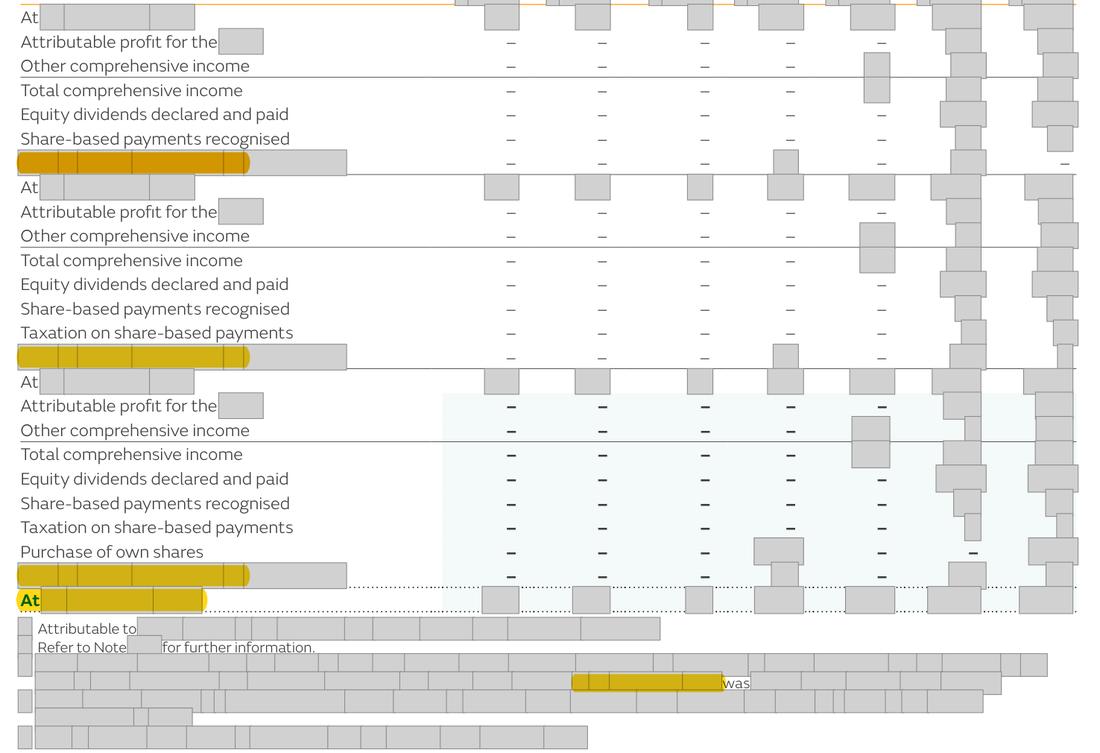
Further pages withheld to protect the company’s identity (two): Annual Report 2025, page 259; Annual Report 2024, page 240. Their wording or layout could lead back to the company even with names and figures masked; the evidence list below records what each page shows.
Names, figures, dates, logos and any wording that could be searched back to the company are boxed out in grey; the point is highlighted in yellow.
What the report shows, and what the rule requires
| What the annual report shows | What the rule requires |
|---|---|
| What the annual report shows Policy: '[wording masked]'. Practice: '[wording masked]' takes [amount] out of treasury shares with a [amount] charge to retained earnings (2024: [amounts]); share premium is [amount] at every date. | What the rule requires A policy that matches the practice: the cost of treasury shares reissued is removed from the treasury share reserve and any shortfall of the proceeds below cost is charged to retained earnings; only a surplus of proceeds over cost would be credited to share premium. |
What we checked: Read the equity policy in both reports against the group and Company statements of changes in equity and the treasury share movement table.
The rule
IAS 1 Presentation of Financial Statements, paragraph 117
Version relied on: UK-adopted international accounting standards (UK Endorsement Board), as in force for financial years beginning in or after January 2025
The accounts must disclose the entity's material accounting policy information.
IAS 32 Financial Instruments: Presentation, paragraph 33
Version relied on: UK-adopted international accounting standards (UK Endorsement Board), as in force for financial years beginning in or after January 2025
Buying, selling, issuing or cancelling the entity's own shares never produces a gain or loss in profit or loss.
Why it applies here: Stated accounting policy does not describe the treatment applied in either year.
Why it matters
A reader of the policy would expect share premium to absorb reissue deficits; the statements show it does not, so the policy note misdescribes the treatment of [amount] (2025) and [amount] (2024).
Exposure
No sanction: a wording correction to the policy note.
Our workings
the policy in Note 19 (both reports) says the surplus or deficit on a sale or reissue of treasury shares is presented within share premium. The group statement of changes in equity shows, for '[wording masked]', [amount] released from treasury shares, [amount] charged to retained earnings and [amount] net in total equity in 2025, and [amounts] in 2024; the Company statement shows the same. Share premium stays at [amount] throughout.
proceeds of [amount] against cost of [amount] leave a deficit of [amount] in 2025 and [amount] in 2024 (see workings).
IAS 32.33 requires the consideration paid or received for own shares to be recognised directly in equity and does not prescribe the reserve; the statements use retained earnings, where the share-based payment credits also sit, so the policy text does not describe the treatment applied. Because the policy note is where IAS 1.117 requires the entity to say what it does, a sentence that describes a different treatment is a presentation inconsistency, not a measurement error: no figure in the statements is wrong.
| Item | Computation | Result |
|---|---|---|
| 2025 deficit charged to retained earnings | [n] - [n] = [n] | [n] |
| 2024 deficit charged to retained earnings | [n] - 1 = [n] | [n] |
Management’s best defence, and our reply
Management would say the transfers to plan participants are settlements of share awards rather than sales, so the sentence about sales and reissues was never meant to cover them, and the share-based payment credit in retained earnings is the natural place to absorb the cost. They would add that nothing in the statements is misstated. That explains the practice and agrees that the numbers are right, but the policy expressly covers shares 'reissued', which is what the transfers are, and no other policy describes the retained-earnings treatment.
The fix
- Reword the policy: 'When treasury shares are reissued, their cost is removed from the treasury share reserve; any excess of cost over the proceeds is charged to retained earnings and any excess of proceeds over cost is credited to share premium.'
Evidence relied on
| # | What it shows | Type | Where |
|---|---|---|---|
| 1 | The stated policy for reissued treasury shares (2025) | Document | Annual Report 2025, page 259 |
| 2 | 2025: deficit of [amount] charged to retained earnings, share premium unchanged | Document | Annual Report 2025, page 214 |
| 3 | 2024: deficit of [amount] charged to retained earnings | Document | Annual Report 2025, page 214 |
| 4 | Share premium of [amount], unchanged from every earlier date | Document | Annual Report 2025, page 214 |
| 5 | The same policy sentence in the 2024 report | Document | Annual Report 2024, page 240 |
Prepared by Pramanex from the company’s published annual reports, without the company’s involvement, to show how an annual report review reads. The company is not named, and nothing on this page is a statement about any identifiable company. Observations are not an audit, review or other assurance engagement, and not legal advice. A regulator-style question is a question, not a conclusion.
Want this on your own annual report, before it is published?
Start with three free findings on your latest published annual report, or talk to us about a fixed-fee pre-publication review.
Your annual report will be in draft before the year-end audit.
Have it read before it is published.
Under NDA, with our reviewer on your insider list under UK MAR.