1.21 A [amount] 'retirement benefits obligation cost' charged to 2024 operating profit does not appear anywhere in the pension note
UK Company C · an AIM-quoted scientific instruments group · Regulator-style question
In brief
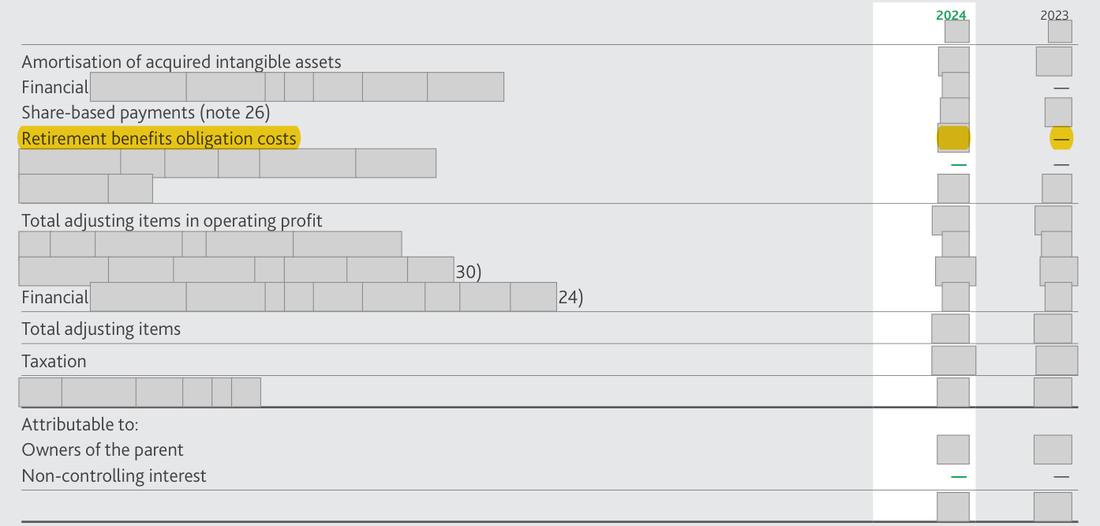
Both reports show a [amount] 'retirement benefits obligation cost' in 2024 operating costs, treated as an adjusting item. The defined benefit pension note for 2024 shows no expense, no employer contribution, no past service cost and no settlement, and states there were none. The charge therefore cannot be traced to the scheme's IAS 19 movement, and the report does not say what it is.
The evidence, as filed
Further pages withheld to protect the company’s identity (four): Annual Report 2025, page 77; Annual Report 2024, page 96; Annual Report 2025, page 96; Annual Report 2024, page 19. Their wording or layout could lead back to the company even with names and figures masked; the evidence list below records what each page shows.
Names, figures, dates, logos and any wording that could be searched back to the company are boxed out in grey; the point is highlighted in yellow.
What the report shows, and what the rule requires
| What the annual report shows | What the rule requires |
|---|---|
| What the annual report shows Note 4 and note 5: 'Retirement benefits obligation costs' [amount] in 2024 (2025: nil). Note 30 (2024): contributions by the Company nil, expenses nil, current and past service cost nil; '[wording masked]'. | What the rule requires Either the charge appears in the IAS 19 reconciliation in the line that fits it (for example past service cost or a settlement loss, or plan expenses), or the report explains that it is a cost outside the scheme (for example advisers' fees on the buy-in) and labels it accordingly. |
What we checked: Adjusting-items and operating-cost notes in both reports; the 2024 plan-asset and obligation reconciliations; the statement on amendments, curtailments and settlements; the Chief Financial Officer's pension paragraph in both reports; the cash-flow adjustments.
The rule
IAS 19 Employee Benefits, paragraph 141(d)
Version relied on: UK-adopted international accounting standards (UK Endorsement Board), as in force for financial years beginning in or after January 2025
Past service cost and settlement gains and losses must be shown in the reconciliation of the defined benefit liability (they may be combined if they occur together).
Why it applies here: A [amount] pension-labelled charge with no counterpart in the pension note and no explanation.
Why it matters
Readers cannot reconcile the pension charge in the income statement to the pension note, and the label suggests a scheme cost that the note says did not arise.
Exposure
A question; no breach is alleged until the nature of the charge is known.
Our workings
the 2024 report's note 4 shows 'Retirement benefits obligation costs' of [amount] within adjusting items in operating profit, and note 5 shows the same amount in total operating costs; the 2025 report repeats the 2024 comparative. Note 30 in both reports shows, for 2024, plan assets moving from [amount] to [amount] through interest income [amount], return on assets [amount] and benefits paid [amount], and the obligation from [amount] to [amount] through interest [amount], financial-assumption gains [amount] and benefits paid [amount], with expenses, contributions and service costs all nil and no settlements.
the reconciliations fully explain the movement in the surplus (workings), leaving no room for a [amount] charge against the scheme.
the charge is either an IAS 19 cost that the reconciliations required by IAS 19.141 omit, or a cost borne outside the scheme (the Chief Financial Officer's report describes the [date] buy-in and the start of wind-up) that the label presents as a pension obligation cost. Which it is only management can say.
| Item (2024) | Computation | Result |
|---|---|---|
| Plan assets roll-forward | [n] + [n] - [n] - [n] | [n] |
| Obligation roll-forward | [n] + [n] - [n] - [n] | [n] |
| Movement in surplus explained by the note | ([n] - [n]) - ([n] - [n]) | -[n] |
| Charged to operating profit but not in the note | [n] | [n] |
| Size against 2024 profit before tax | [n] / [n] | [n]% |
Management’s best defence, and our reply
The company may say the [amount] was professional fees and other costs it paid directly in connection with the buy-in and wind-up, which are not plan transactions and so rightly sit outside the IAS 19 reconciliations; it was disclosed separately as an adjusting item precisely so that readers could see it. That is a reasonable treatment, which is why this is put as a question. However, the label 'retirement benefits obligation costs' implies a cost of the obligation itself, and neither report says what the amount is, so readers cannot tell which reading is right.
The fix
- Explain the [amount] in note 4 (for example 'advisers' fees on the pension buy-in borne by the Company') or include it in the note [n] reconciliation in the line it belongs to.
Question for the company
What is the [amount] 'retirement benefits obligation cost' charged to 2024 operating profit: an IAS 19 cost of the [subsidiary] scheme (and if so, why does the note [n] reconciliation not show it), or a cost incurred outside the scheme (for example advisers' fees on the buy-in or wind-up), and if the latter, will the label and note be changed?
Evidence relied on
| # | What it shows | Type | Where |
|---|---|---|---|
| 1 | 2024 report, note 4: [amount] pension-labelled charge in operating-profit adjusting items | Document | Annual Report 2024, page 77 |
| 2 | 2024 plan-asset reconciliation: no expense or contribution | Document | Annual Report 2024, page 96 |
| 3 | 2024 obligation reconciliation: no service cost, past service cost or expense | Document | Annual Report 2024, page 96 |
| 4 | The note rules out a settlement or past service cost | Document | Annual Report 2024, page 96 |
| 5 | 2025 report repeats the [amount] 2024 charge | Document | Annual Report 2025, page 77 |
| 6 | 2025 report: 2024 column again shows no expense or contribution | Document | Annual Report 2025, page 96 |
| 7 | The 2024 event that may explain a one-off cost | Document | Annual Report 2024, page 19 |
Prepared by Pramanex from the company’s published annual reports, without the company’s involvement, to show how an annual report review reads. The company is not named, and nothing on this page is a statement about any identifiable company. Observations are not an audit, review or other assurance engagement, and not legal advice. A regulator-style question is a question, not a conclusion.
Want this on your own annual report, before it is published?
Start with three free findings on your latest published annual report, or talk to us about a fixed-fee pre-publication review.
Your annual report will be in draft before the year-end audit.
Have it read before it is published.
Under NDA, with our reviewer on your insider list under UK MAR.