1.02 The [amount] impairment of [subsidiary] and [subsidiary] is disclosed without the recoverable amounts, the basis used or the units' own assumptions (group and parent company accounts)
UK Company C · an AIM-quoted scientific instruments group · Compliance or disclosure gap
In brief
In 2025 the group wrote off the whole goodwill of [subsidiary] and [subsidiary] ([amount]) and [amount] of [subsidiary]'s acquired intangible assets: [amount] against profit before tax of [amount]. For each unit that takes a material impairment loss, IAS 36 paragraph 130 requires the recoverable amount, whether it is value in use or fair value less costs of disposal, and the discount rate or fair-value inputs used. The notes give none of these for either unit and do not split the loss between them; the split ([amount] [subsidiary], [amount] [subsidiary]) appears only [wording masked] and in the acquisitions note. The [subsidiary] loss equals the [amount] earn-out released and is called 'counterbalancing', so without the recoverable amount a reader cannot tell whether it was measured or set to offset the credit. The parent company's own accounts do the same for the [amounts] impairments of its investments in [subsidiary] and [subsidiary].
The evidence, as filed
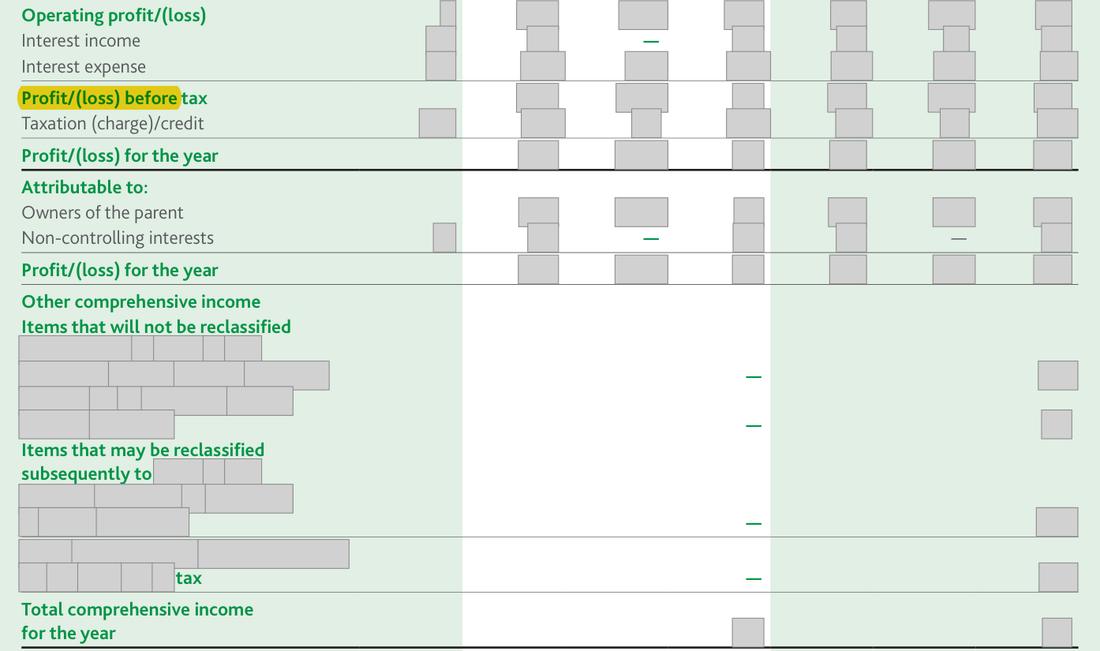
Further pages withheld to protect the company’s identity (six): Annual Report 2025, page 82; Annual Report 2024, page 80; Annual Report 2025, page 95; Annual Report 2025, page 20; Annual Report 2025, page 104; Annual Report 2025, page 77. Their wording or layout could lead back to the company even with names and figures masked; the evidence list below records what each page shows.
Names, figures, dates, logos and any wording that could be searched back to the company are boxed out in grey; the point is highlighted in yellow.
What the report shows, and what the rule requires
| What the annual report shows | What the rule requires |
|---|---|
| What the annual report shows Note 13: goodwill of [subsidiary] and [subsidiary] 'fully impaired', charge [amount]; note [n]: impairment [n] of acquired intangibles; note [n]: [amount] of [subsidiary] goodwill and intangibles impaired. No recoverable amount, no basis (value in use or fair value less costs of disposal), no unit discount rate or multiple; one discount-rate range ([n]%-[n]%) and one multiple range (11-13 times) for all [n] units. Parent company note 5: investment impairments of [amount] ([subsidiary]) and [amount] ([subsidiary]), total ([n]), with no recoverable amount or basis. | What the rule requires For each of [subsidiary] and [subsidiary]: the events that led to the loss, the loss by class of asset (goodwill, technology, brand, customer relationships), the recoverable amount and whether it is value in use or fair value less costs of disposal, and the discount rate (value in use) or the fair-value level, technique and key assumptions. The same for the parent company's impaired investments in [subsidiary] and [subsidiary] (FRS 101 exempts a qualifying parent only from paragraph 130(f)(ii)-(iii)). |
What we checked: Notes 2, 4, 13, 14 and 29, the segment note, the Chief Financial Officer's report and the key audit matter, against the IAS 36 paragraph 130 list, item by item.
The rule
IAS 36 paragraph 130(e)
Version relied on: UK-adopted international accounting standards (UK Endorsement Board), as in force for financial years beginning in or after January 2025
For an impaired asset or unit, the accounts must give its recoverable amount and say whether that is fair value less costs of disposal or value in use.
IAS 36 paragraph 130 lead-in
Version relied on: UK-adopted international accounting standards (UK Endorsement Board), as in force for financial years beginning in or after January 2025
The impairment disclosures apply to each individual asset or cash-generating unit for which an impairment loss was recognised or reversed in the period.
FRS 101 paragraph 8(l) (disclosure exemptions for a qualifying entity: IAS 36)
Version relied on: FRS 101 / FRS 102, FRC, as amended and in force for the financial year reviewed
A qualifying entity under the reduced-disclosure framework is exempt from specified goodwill and impairment disclosures, but only if equivalent disclosures are in the consolidated accounts that include it.
Why it applies here: the matrix below shows (e) and (f) absent and (a), (b), (d)(ii) and (g) only partly given; the per-unit split exists (it is in the strategic report), so the omission is a disclosure choice, not a lack of data.
Why it matters
- Readers cannot judge how far below carrying amount the two businesses fell, whether fair value or value in use was decisive, or how close other units on the same assumptions are to impairment.
Readers cannot judge how far below carrying amount the two businesses fell, whether fair value or value in use was decisive, or how close other units with the same assumptions are to impairment; the required basis for checking the [amount] charge is missing from the audited notes.
What the regulator has said on this point
Impairment tops the FRC's list of questions for the third successive year (Annual Review of Corporate Reporting 2024/25), which asks for the key inputs and assumptions used in impairment testing and the sensitivity of recoverable amounts to reasonably possible changes.
Source: Annual Review of Corporate Reporting 2024/25, annual review, 2025
Exposure
A Financial Reporting Council enquiry;
Our workings
note [n] says that '[wording masked] [subsidiary] and [subsidiary] [wording masked] a charge of [amount]; note [n] shows an impairment column of [n] against acquired technology ([n]), brand ([n]) and customer relationships ([n]); note [n] says that because of 'the short term outlook' [amount] of [subsidiary] goodwill and intangible assets were impaired; the Chief Financial Officer's report gives [amount] for [subsidiary], 'the entire goodwill asset'. The notes describe the impairment method only for the population: value in use, five-year projections, one discount-rate range of [n]%-[n]% for all units, and an EBIT multiple of 11-13 times '[wording masked]', without saying which units. The auditor's key audit matter confirms that [wording masked] for some units.
[n] + [n] = [n], equal to [n] + [n] = [n]; the loss is [n] / [n] = 48% of profit before tax, [subsidiary] alone [n] / [n] = [n]% and [subsidiary] [n] / [n] = [n]%, so each loss is material on its own and paragraph 131's aggregate route is not available. Law: IAS 36 paragraph 130 applies to each individual asset or cash-generating unit for which an impairment loss is recognised (subject to materiality; paragraph 131 covers losses that are not individually material): (a) events, (b) amount, (d)(ii) loss by class of asset and segment, (e) the recoverable amount and whether it is fair value less costs of disposal or value in use, (f) for fair value less costs of disposal the level, technique and key assumptions, (g) for value in use the discount rate used now and previously.
A further point: [subsidiary] was bought on [date]; its goodwill and intangibles are written off eighteen months later, and the notes call the cause 'medium term reduced outlook' in one place and 'short term outlook' in another. Two further facts. The Chief Financial Officer's report says the [subsidiary] earn-out release gave 'a [amount] credit to profit' and 'a [amount] counterbalancing impairment', and note 4 shows '[wording masked]' ([n]); IAS 36 paragraph 59 measures a loss as carrying amount less recoverable amount and IFRS 3 takes the earn-out release to profit on its own, so the equality of the two amounts is exactly what the missing recoverable amount would explain. In the parent company's accounts (prepared under the reduced disclosure framework), note 5 says the review 'identified indicators of impairment in [subsidiary] and [subsidiary] for which impairments of [amounts] were recorded', again with no recoverable amount or basis; paragraph 8(l) of that framework exempts a qualifying entity only from paragraph 130(f)(ii) and (iii), not from [n](e). The Chief Financial Officer's report says the [subsidiary] investment was written down in full, so for [subsidiary] the missing item is mainly the basis; for [subsidiary] both the recoverable amount and the basis are missing from the notes.
| IAS 36 paragraph 130 item | [subsidiary] | [subsidiary] | Status |
|---|---|---|---|
| (a) events and circumstances | 'medium term reduced outlook' (note [n]) | 'medium term' (note [n]) vs 'short term outlook' (note [n]) | Partial |
| (b) amount of loss per unit | not in notes ([n] in strategic report) | [n] (note [n]) | Partial |
| (d)(ii) loss by class of asset | goodwill only (by inference) | goodwill + [n] intangibles, not split by unit | Partial |
| (e) recoverable amount and basis | not given | not given | Absent |
| (f) fair value level, technique, key assumptions | not given (11-13 times for 'where followed') | not given | Absent |
| (g) value-in-use discount rate, current and previous | group range [n]%-[n]% only | group range only | Partial |
| Loss total and size | [n] + [n] = [n]; [n] / [n] = [n]% | [n] + [n] = [n]; [n] / [n] = [n]% | [n] / [n] = 48% of profit before tax; each material on its own |
| Parent company investment impairments (note 5) | [subsidiary] [n] | [subsidiary] [n] ([subsidiary]: none) | [n] + [n] = [n]; no recoverable amount or basis |
Management’s best defence, and our reply
The finance team will say the two businesses are small within a group of nineteen units, that the losses are explained in the strategic report and the acquisitions note, and that publishing the recoverable amount of a small subsidiary is commercially sensitive. They may add that the [subsidiary] loss is matched by the [amount] release of its earn-out, so the net effect on profit is nil, and that the strategic report says the parent's [subsidiary] investment was written down in full. However, paragraph 130 is triggered by each material loss, and [n] and [n] are each over a fifth of profit before tax; the earn-out release is a separate remeasurement under IFRS 3 and does not offset the disclosure duty; commercial sensitivity is not an exemption in IAS 36, and FRS 101 removes only part of paragraph 130(f) for the parent; and the strategic report is outside the audited notes and gives no recoverable amount or basis either.
The fix
- Add to note [n]: '[subsidiary]: impairment [amount] (goodwill); recoverable amount £[x]m on a [value in use / fair value less costs of disposal] basis; pre-tax discount rate [x]% (2024: [x]%). [subsidiary]: impairment [amount] (goodwill [amount], technology [amount], brand [amount], customer relationships [amount]); recoverable amount £[x]m on a [basis]', with the events for each.
Evidence relied on
| # | What it shows | Type | Where |
|---|---|---|---|
| 1 | Goodwill of the two units written off: [amount], cause stated in one phrase | Document | Annual Report 2025, page 82 |
| 2 | Impairment of acquired intangibles [n], by class but not by unit | Document | Annual Report 2025, page 82 |
| 3 | [subsidiary] loss [amount], cause described as short-term | Document | Annual Report 2025, page 95 |
| 4 | [subsidiary] loss [amount] is given only in the strategic report | Document | Annual Report 2025, page 20 |
| 5 | One discount-rate range for all units | Document | Annual Report 2025, page 82 |
| 6 | Fair value less costs of disposal used for unnamed units | Document | Annual Report 2025, page 82 |
| 7 | Profit before tax 2025: [n] | Document | Annual Report 2025, page 65 |
| 8 | Parent impairments of the investments in [subsidiary] ([amount]) and [subsidiary] ([amount]) | Document | Annual Report 2025, page 104 |
| 9 | Total 2025 impairment of investments [amount] | Document | Annual Report 2025, page 104 |
| 10 | The [subsidiary] impairment is presented as 'counterbalancing' the [amount] earn-out release | Document | Annual Report 2025, page 20 |
| 11 | Earn-out release [n] in adjusting items, equal to the [subsidiary] impairment | Document | Annual Report 2025, page 77 |
Absence check
- Document
- Annual Report 2025
- Where it would appear
- [n]. Goodwill continued
- What is missing
- the recoverable amount of [subsidiary] and of [subsidiary], whether each is value in use or fair value less costs of disposal, and the unit discount rate or fair-value level and inputs
- Pages looked at
- p.20, [n], 71-72, [n], 81-82, [n]
- Result
- 'recoverable amount' hits p.20 (a calculation 'was performed', no amount), [n] (auditor's procedures), [n] (policy definition), [n] (generic sensitivity sentence) and [n] (parent company's [subsidiary] investment): none gives an amount for either unit. 'fair value less' hits p.61 (auditor), [n] (generic multiple range) and [n] ([subsidiary]): no unit named. '[subsidiary]' and '[subsidiary]' hit the business review, sustainability pages, the pension note, the subsidiaries list, p.20 (loss amount only) and p.95 ([subsidiary] earn-out and loss amount): none gives a recoverable amount or basis. 'Level 3' hits p.90 only, the fair-value hierarchy for derivatives.
Absence check
- Document
- Annual Report 2025
- Where it would appear
- [wording masked]
- What is missing
- the recoverable amounts of the investments in [subsidiary] and [subsidiary] and whether each is value in use or fair value less costs of disposal
- Pages looked at
- p.102 (parent policies and estimates), p.104 (note 5), p.20 (strategic report on impairment), p.82 (group note [n])
- Result
- 'recoverable amount' hits p.20 (method narrative), p.61 (auditor's report), p.72 (policy), p.82 (group goodwill headroom) and p.104 (the 2024 [subsidiary] explanation), none giving the 2025 recoverable amounts of these two investments; 'value in use' hits p.20, [n] (policy, group goodwill and the [subsidiary] explanation); 'fair value less costs' hits p.61 and [n] (auditor's work and the [subsidiary] explanation).
Prepared by Pramanex from the company’s published annual reports, without the company’s involvement, to show how an annual report review reads. The company is not named, and nothing on this page is a statement about any identifiable company. Observations are not an audit, review or other assurance engagement, and not legal advice. A regulator-style question is a question, not a conclusion.
Want this on your own annual report, before it is published?
Start with three free findings on your latest published annual report, or talk to us about a fixed-fee pre-publication review.
Your annual report will be in draft before the year-end audit.
Have it read before it is published.
Under NDA, with our reviewer on your insider list under UK MAR.