6.18 2024 basis of reporting says the Company Code training completion rate was disclosed; no rate is given in the 2024 report
UK Company B · a UK-listed technology and logistics group · Drafting slip
In brief
The 2024 non-financial basis of reporting says the Company Code training completion percentage at [date] has been disclosed, but no percentage appears in the 2024 report; the 2025 report marks the 2024 comparative as not disclosed.
The evidence, as filed
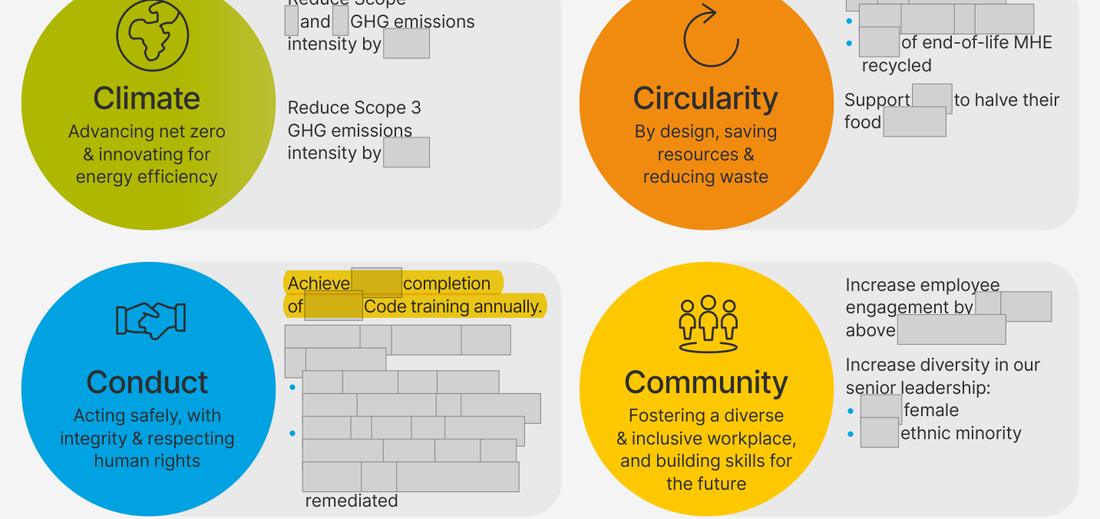
Further pages withheld to protect the company’s identity (three): Annual Report 2025, page 66; Annual Report 2024, page 58; Annual Report 2024, page 243. Their wording or layout could lead back to the company even with names and figures masked; the evidence list below records what each page shows.
Names, figures, dates, logos and any wording that could be searched back to the company are boxed out in grey; the point is highlighted in yellow.
What the report shows, and what the rule requires
| What the annual report shows | What the rule requires |
|---|---|
| What the annual report shows 2024 report p.243: '[wording masked] [date].'; no percentage in the report. | What the rule requires The basis of reporting saying the 2024 rate was not disclosed (the refreshed training launched in [date]), or the rate given. |
Why it matters
A one-line correction to the basis of reporting; no figure is affected.
Exposure
Voluntary sustainability metric; no regulatory consequence.
Our workings
the 2024 report sets a target of above 95% completion of the Company Code training annually; its basis of reporting defines the rate and says the percentage at [date] has been disclosed; a whole-report search finds no percentage. The 2025 report gives [n]% for 2025 and 'ND' for 2024 with the footnote 'Comparative not disclosed.'
Management’s best defence, and our reply
The refreshed training launched only in [date] and many completion deadlines fell after the year end, so a year-end rate would have been misleading; the sentence was carried over from the methodology prepared for the assurance provider. That explains why the figure was withheld, not why the report says it was disclosed, so a one-line correction remains due.
The fix
- State in the basis of reporting that the 2024 completion rate was not disclosed because the refreshed training launched in [date].
Evidence relied on
| # | What it shows | Type | Where |
|---|---|---|---|
| 1 | The 2030 sustainability targets include the Company Code training completion above 95% every year. | Document | Annual Report 2024, page 48 |
| 2 | The Conduct section describes the training but gives no completion rate. | Document | Annual Report 2024, page 58 |
| 3 | The basis of reporting states that the completion percentage at the year end has been disclosed. | Document | Annual Report 2024, page 243 |
| 4 | The 2025 report gives [n]% for 2025 and no 2024 figure. | Document | Annual Report 2025, page 66 |
| 5 | The 2025 report's footnote confirms the 2024 rate was not published. | Document | Annual Report 2025, page 66 |
Absence check
- Document
- Annual Report 2024
- Where it would appear
- We launched a refreshed the Company Code
- What is missing
- The Company Code training completion percentage at [date]
- Pages looked at
- Annual Report [amount].48 and [n] (targets and metrics tables), 60-61 (Conduct section), [n] (risk management), [n] (Audit Committee report), [n] (basis of reporting)
- Result
- 'training completion' and 'completed the training' hit only the basis of reporting, which defines the metric and gives no figure. 'completion rate' also hits the Audit Committee report (p.101: 'investigation completion rates' for whistleblowing and 'good completion rates' for compliance training, with no percentage). 'the Company Code' hits the targets, the Conduct section, the risk management review and the Audit Committee report; none gives a completion percentage.
Prepared by Pramanex from the company’s published annual reports, without the company’s involvement, to show how an annual report review reads. The company is not named, and nothing on this page is a statement about any identifiable company. Observations are not an audit, review or other assurance engagement, and not legal advice. A regulator-style question is a question, not a conclusion.
Want this on your own annual report, before it is published?
Start with three free findings on your latest published annual report, or talk to us about a fixed-fee pre-publication review.
Your annual report will be in draft before the year-end audit.
Have it read before it is published.
Under NDA, with our reviewer on your insider list under UK MAR.