6.09 The high-risk supplier social-audit KPI is labelled as a share of suppliers but is calculated as a share of spend
UK Company B · a UK-listed technology and logistics group · Drafting slip
In brief
The Conduct target and metrics table describe the measure as the percentage of high-risk suppliers that [wording masked], reported at [n]%. The basis of reporting on page 277 calculates it instead as the share of procurement spend with high-risk suppliers that hold a valid [wording masked] label should say that the figure is spend-weighted; otherwise it cannot be read against the page 71 narrative of [n] high-risk facilities with critical non-conformances at 7. The 2024 report mixes the same two bases (both years).
The evidence, as filed
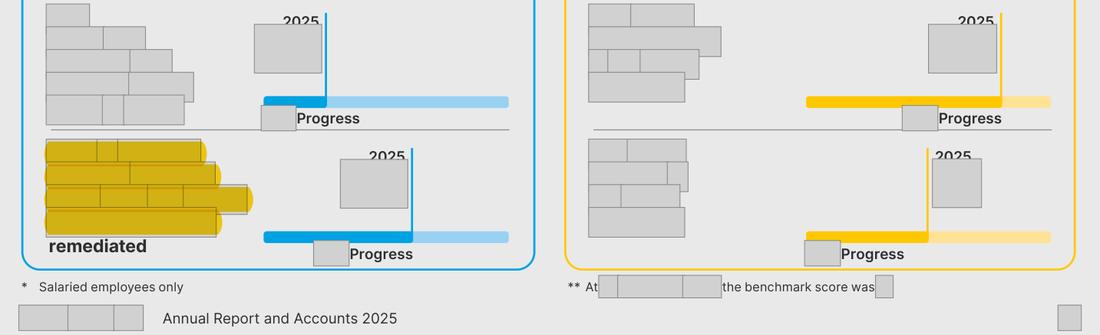
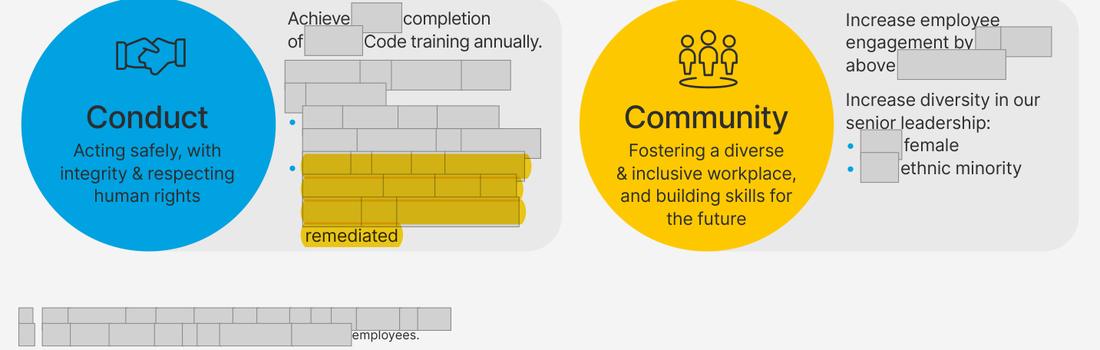
Further pages withheld to protect the company’s identity (five): Annual Report 2025, page 66; Annual Report 2024, page 63; Annual Report 2024, page 243; Annual Report 2025, page 277; Annual Report 2025, page 71. Their wording or layout could lead back to the company even with names and figures masked; the evidence list below records what each page shows.
Names, figures, dates, logos and any wording that could be searched back to the company are boxed out in grey; the point is highlighted in yellow.
What the report shows, and what the rule requires
| What the annual report shows | What the rule requires |
|---|---|
| What the annual report shows Page [n] label: '% [wording masked]' - [n]%; basis of reporting: numerator is [wording masked]. | What the rule requires A label that matches the basis, for example '% of spend with high-risk suppliers that have a valid social audit and no open critical non-conformances', used the same way on pages 55, 66 and 277. |
Why it matters
Readers may take the [n]% as a share of suppliers and find it inconsistent with the facility counts in the narrative.
Exposure
Voluntary sustainability metric; no regulatory consequence.
Our workings
the target panel on page 55 and the metrics table on page 66 describe a count of suppliers; the basis of reporting on page 277 defines a spend-weighted measure (spend with qualifying high-risk suppliers divided by spend with all high-risk suppliers), and its title uses 'no critical nonconformances' where the table says 'remediated any critical non-conformances'.
Management’s best defence, and our reply
The company could say the basis of reporting, which is cross-referenced from the table footnote, defines the metric fully, and that weighting by spend focuses the measure on the suppliers that matter most. It could add that the narrative counts facilities, which are a different unit from suppliers. However, the table and target labels themselves describe a count of suppliers, so a reader of the Sustainability Report alone is told something different from what is measured; the fix is a relabel, not a change of method.
The fix
- Relabel the target and the table line as a share of spend with high-risk suppliers, and use one wording for the qualifying condition on pages 55, 66 and 277.
Evidence relied on
| # | What it shows | Type | Where |
|---|---|---|---|
| 1 | Metrics table label (count of suppliers) and the FY25 figure | Document | Annual Report 2025, page 66 |
| 2 | 2030 target panel uses the same count-based wording | Document | Annual Report 2025, page 55 |
| 3 | Basis of reporting: the metric is spend-weighted | Document | Annual Report 2025, page 277 |
| 4 | Basis of reporting: qualifying condition differs in wording from the table label | Document | Annual Report 2025, page 277 |
| 5 | Narrative counts facilities, not spend | Document | Annual Report 2025, page 71 |
| 6 | Narrative count of facilities with critical non-conformances | Document | Annual Report 2025, page 71 |
| 7 | The 2024 table gives high-risk suppliers as [n]% of spend, with no stated denominator. | Document | Annual Report 2024, page 63 |
| 8 | The audited-and-clean measure is 5% against a 100% target. | Document | Annual Report 2024, page 63 |
| 9 | The basis of reporting computes the 5% as a share of spend with high-risk suppliers, a different base from the [n]% row above it. | Document | Annual Report 2024, page 243 |
| 10 | The 2030 target is worded as a share of suppliers, not of spend. | Document | Annual Report 2024, page 48 |
| 11 | The narrative says all ten high-risk facilities were assessed, which a reader cannot square with the [n]% and 5% rows. | Document | Annual Report 2024, page 63 |
Prepared by Pramanex from the company’s published annual reports, without the company’s involvement, to show how an annual report review reads. The company is not named, and nothing on this page is a statement about any identifiable company. Observations are not an audit, review or other assurance engagement, and not legal advice. A regulator-style question is a question, not a conclusion.
Want this on your own annual report, before it is published?
Start with three free findings on your latest published annual report, or talk to us about a fixed-fee pre-publication review.
Your annual report will be in draft before the year-end audit.
Have it read before it is published.
Under NDA, with our reviewer on your insider list under UK MAR.