2.18 The Audit Committee's significant issues leave out the auditor's key audit matter on promotional allowances, and name goodwill impairment as a focus without a row
UK Company B · a UK-listed technology and logistics group · Regulator-style question
In brief
The auditor reported two key audit matters for 2024: capitalisation of labour costs, and [former subsidiary]'s accounting for promotional allowances received from suppliers, which it treated as a potential fraud risk. The Audit Committee's table of significant issues covers capitalisation but has no row for promotional allowances, and the Committee's report does not mention them. The same report names goodwill impairment as a key area of focus, but the table has no goodwill row. The Board is asked whether these were significant issues and how they were addressed.
The evidence, as filed
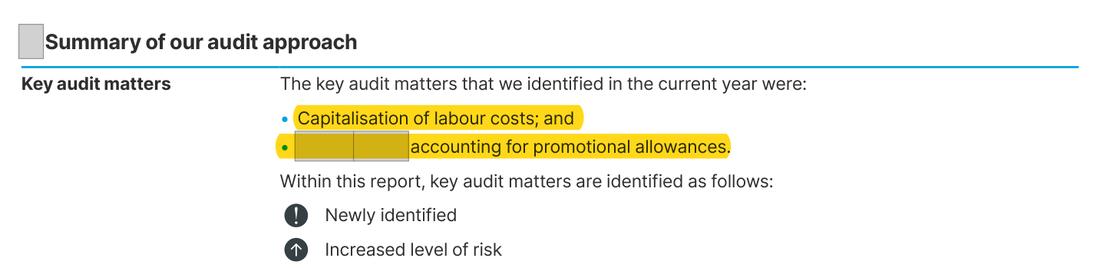
Further pages withheld to protect the company’s identity (six): Annual Report 2025, page 123; Annual Report 2024, page 160; Annual Report 2024, page 116; Annual Report 2024, page 115; Annual Report 2024, page 117; Annual Report 2024, page 118. Their wording or layout could lead back to the company even with names and figures masked; the evidence list below records what each page shows.
Names, figures, dates, logos and any wording that could be searched back to the company are boxed out in grey; the point is highlighted in yellow.
What the report shows, and what the rule requires
| What the annual report shows | What the rule requires |
|---|---|
| What the annual report shows Auditor's report: key audit matters 'Capitalisation of labour costs' and '[former subsidiary]: accounting for promotional allowances' (a potential fraud risk). Audit Committee table: rows for consolidation of [former subsidiary], Solutions revenue, refinancing, capitalisation of internal development costs, adjusting items, the [partner] contingent consideration and customer-level impairment; no row or mention of promotional allowances; goodwill impairment named as a key area of focus on p.115 with no row. | What the rule requires Either a row for promotional allowances (and for goodwill impairment, if it was a significant issue) saying how the Committee addressed it, or a sentence explaining why the Committee did not treat the auditor's key audit matter as a significant issue. |
The rule
UK Corporate Governance Code 2018, Provision 26 (first bullet)
Version relied on: UK Corporate Governance Code, FRC, July 2018; applies to financial years beginning from January 2019 (the 2024 edition applies from January 2025)
The annual report should describe the work of the audit committee, including: ... the significant issues that the audit committee considered relating to the financial statements, and how these issues were addressed
Why it applies here: the Committee's report does not show whether the Committee considered the auditor's fraud-risk matter, or goodwill impairment, as significant issues, or how it addressed them.
Why it matters
Shareholders cannot tell whether the Committee examined a matter the auditor identified as among the most significant in the audit and as a potential fraud risk, or why it was not treated as a significant issue.
Exposure
A Code reporting matter (comply or explain); no statutory sanction. It may draw questions from investors or in an FRC review of audit committee reporting.
Our workings
the auditor's report lists two key audit matters and describes [wording masked] as a potential fraud risk (pp.157, [n]). The Committee's table says its [wording masked]' but contains no promotional-allowance row; a search of the whole report finds the term only in the auditor's report and in Note 2.9. The Committee's areas-of-focus paragraph names 'goodwill impairment assessment'; the table's only impairment row concerns customer-level cash-generating units.
Under the 2018 Code the significant issues are the Committee's own judgement, so this is put as a question rather than a breach.
| Auditor's key audit matter | Audit Committee significant-issues table (pp.116-117) |
|---|---|
| Capitalisation of labour costs | Row: capitalisation of internal development costs |
| [former subsidiary]: accounting for promotional allowances | No row; not mentioned in the Committee's report |
| Goodwill impairment (named as a key area of focus, p.115) | No row; only customer-level impairment is covered |
| Item | GBP million |
|---|---|
| Promotional allowances received in 2024 (p.160, printed as [amount]) | [n] |
Management’s best defence, and our reply
The significant issues are the Committee's own judgement and need not mirror the auditor's key audit matters. [former subsidiary] [wording masked], which oversaw supplier income, and the business was a discontinued operation held for sale; goodwill may have been reviewed within the [segment] impairment work. However, the auditor told shareholders that promotional allowances were among the matters of most significance and a potential fraud risk, and the group Committee's report neither lists the matter nor says why it was not significant, so the reader cannot tell whether it was examined at group level. That is for the Committee to explain, so the point is put as a question.
The fix
- Add a row: 'Promotional allowances ([former subsidiary]) - risk of recognising allowances before the promotion is agreed with suppliers; the Committee reviewed ... and agreed ...', or state why it was not a significant issue; align the areas-of-focus list with the table.
Question for the company
Did the Audit Committee consider [former subsidiary]'s promotional allowances (the auditor's key audit matter) and goodwill impairment as significant issues in 2024? If so, how were they addressed; if not, why not?
Evidence relied on
| # | What it shows | Type | Where |
|---|---|---|---|
| 1 | The auditor's two key audit matters for 2024 | Document | Annual Report 2024, page 157 |
| 2 | Size of the promotional allowances in the key audit matter | Document | Annual Report 2024, page 160 |
| 3 | The auditor treats the matter as a potential fraud risk | Document | Annual Report 2024, page 160 |
| 4 | The Committee's table presents its significant issues as the areas the auditor refers to | Document | Annual Report 2024, page 116 |
| 5 | Goodwill impairment named as a key area of focus | Document | Annual Report 2024, page 115 |
| 6 | The table's only impairment row concerns customer-level cash-generating units, not goodwill | Document | Annual Report 2024, page 117 |
| 7 | [former subsidiary] has its own audit committee (relevant to the company's likely answer) | Document | Annual Report 2024, page 118 |
Absence check
- Document
- Annual Report 2024
- Where it would appear
- Adjusting items
- What is missing
- a significant-issue row, or any mention, for [former subsidiary]'s promotional allowances, and a row for goodwill impairment
- Pages looked at
- Annual Report [amount].114-123 (whole Audit Committee Report, page images)
- Result
- 'promotional allowance' appears only in the auditor's report (pp.157, [n]) and Note 2.9; 'commercial income' only on p.42 (assets held for sale) and in Note 2.9; 'supplier income' only in Note 2.9 and p.215; 'goodwill impairment' only in the areas-of-focus sentence on p.115. None is in the Committee's table or its account of how an issue was addressed.
Prepared by Pramanex from the company’s published annual reports, without the company’s involvement, to show how an annual report review reads. The company is not named, and nothing on this page is a statement about any identifiable company. Observations are not an audit, review or other assurance engagement, and not legal advice. A regulator-style question is a question, not a conclusion.
Want this on your own annual report, before it is published?
Start with three free findings on your latest published annual report, or talk to us about a fixed-fee pre-publication review.
Your annual report will be in draft before the year-end audit.
Have it read before it is published.
Under NDA, with our reviewer on your insider list under UK MAR.