2.07 The Directors' Report still describes the 2026 senior notes as outstanding, at a balance its own figures do not produce, although they were repaid on [date]
UK Company B · a UK-listed technology and logistics group · Presentation point
In brief
The Directors' Report says [amount] of the 2026 senior notes remained after the [date] tender and that the notes 'will mature on [date]'. Its own figures give [amount] ([amount] less [amount], and the borrowings note and the Financial review say the final [amount] was repaid on [date], before the year end. The paragraph on the 2025 convertible bonds in the same section does report their final redemption; the 2026 notes paragraph does not.
The evidence, as filed
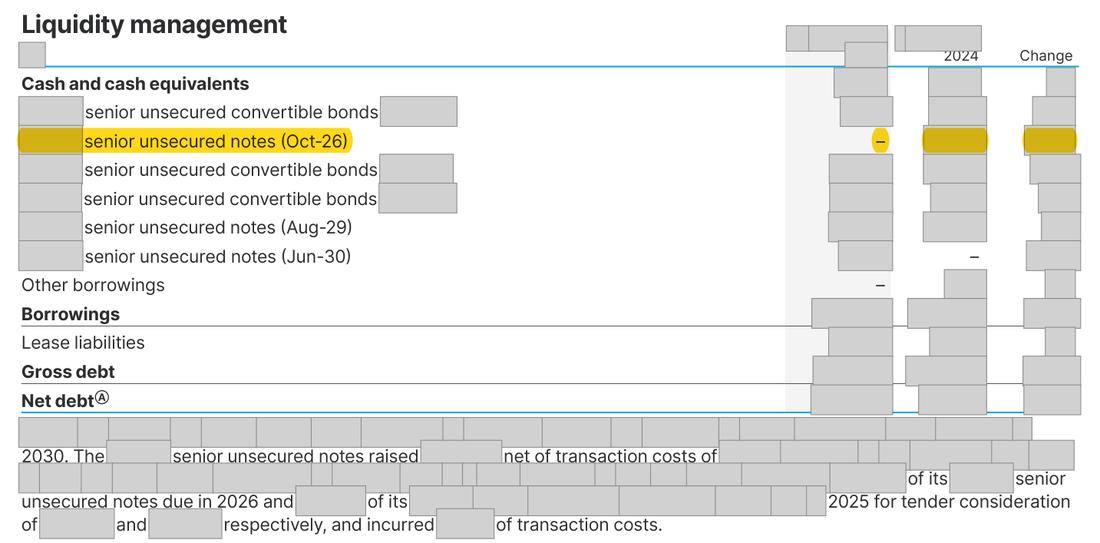
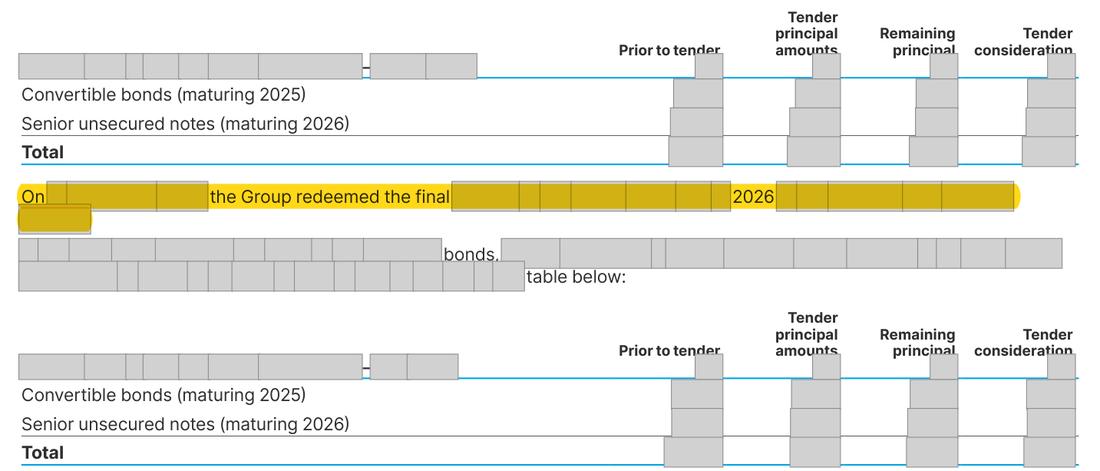
Further pages withheld to protect the company’s identity (two): Annual Report 2025, page 163; Annual Report 2024, page 151. Their wording or layout could lead back to the company even with names and figures masked; the evidence list below records what each page shows.
Names, figures, dates, logos and any wording that could be searched back to the company are boxed out in grey; the point is highlighted in yellow.
What the report shows, and what the rule requires
| What the annual report shows | What the rule requires |
|---|---|
| What the annual report shows Directors' Report p.163: balance after the Second Tender Offer printed as [amount]; notes described as maturing on [date] and redeemable by the Company; no mention of the [date] redemption | What the rule requires Balance after the Second Tender Offer of [amount], followed by a sentence that the remaining notes were redeemed at par on [date] (as the borrowings note says), so that no 2026 notes were outstanding at [date] |
What we checked: Directors' Report bond paragraphs against the borrowings note [n], the Financial review liquidity table, the balance sheet and the 2024 report
The rule
Companies Act 2006 s.463(1)(a) and (2)(a)
Version relied on: Companies Act 2006, revised text on legislation.gov.uk as in force for the financial year reviewed
A director of a company is liable to compensate the company for any loss suffered by it as a result of— (a)any untrue or misleading statement in a report
Why it applies here: the paragraph was rolled forward from the 2024 report without the [date] redemption, and a digit slipped in the new sentence.
Why it matters
A reader of the Directors' Report alone would believe [amount] of notes due in [date] were still in issue at the year end, contradicting the audited balance sheet and the borrowings note.
Exposure
No penalty attaches; the audited figures are right. The Directors' Report is within the reports covered by s.463, so its statements should be accurate.
Our workings
the Directors' Report gives [amount] outstanding after the First Tender Offer and a repurchase of [amount] in the Second Tender Offer, '[wording masked] [amount]'; it then says the notes 'will mature on [date]'. Note 4.1 says the Group 'redeemed the final [amount] [wording masked] 2026' on [date], and the Financial review liquidity table shows nil for the [amount] notes at [date].
[n] - [n] = [n], which is [n] less than the printed balance (workings).
The balance sheet itself is right; the point is that a statutory report describes a debt as live when it had been repaid.
| Step | Figure |
|---|---|
| Outstanding after the Second Tender Offer: [n] - [n] | [n] |
| Balance printed in the Directors' Report | [n] |
| Printed less computed: [n] - [n] | [n] |
Management’s best defence, and our reply
The paragraph is a history of the notes, and the borrowings note, the Financial review and the liquidity table all report the [date] redemption, so a reader of the whole report is not misled about debt at the year end. The [amount] is a one-digit typing slip in a narrative sentence with no effect on any audited figure. However, the Directors' Report is a statutory report in its own right and the paragraph still says the notes 'will mature on [date]', a statement untrue at the year end and at approval; the 2025 bonds paragraph beside it does record the final redemption, so the treatment is inconsistent within the same section.
The fix
- Correct the balance to [amount] and add: 'On [date] the Company redeemed the remaining 2026 Notes [wording masked]; no 2026 Notes remain outstanding.' Drop the forward-looking maturity and call wording.
Evidence relied on
| # | What it shows | Type | Where |
|---|---|---|---|
| 1 | Balance of the 2026 notes after the [date] tender | Document | Annual Report 2025, page 163 |
| 2 | Balance printed after the [date] tender: [n] more than the two figures give | Document | Annual Report 2025, page 163 |
| 3 | The notes are still described as maturing in future | Document | Annual Report 2025, page 163 |
| 4 | By contrast, the 2025 bonds paragraph records their final redemption | Document | Annual Report 2025, page 163 |
| 5 | Borrowings note: the 2026 notes were fully repaid before the year end | Document | Annual Report 2025, page 232 |
| 6 | Liquidity table: nil outstanding at [date] | Document | Annual Report 2025, page 43 |
Absence check
- Document
- Annual Report 2025
- Where it would appear
- Senior unsecured notes due in 2026 listed on
- What is missing
- any statement that the remaining 2026 notes were redeemed on [date]
- Pages looked at
- p.162-165 (Directors' Report bond and change-of-control paragraphs)
- Result
- '[date]', 'redeemed the final' and '[amount]' hit only p.43 (Financial review) and p.232 (borrowings note [n]), which are the sources of the redemption fact, not the Directors' Report; '2026 Notes were redeemed' has no hit
Prepared by Pramanex from the company’s published annual reports, without the company’s involvement, to show how an annual report review reads. The company is not named, and nothing on this page is a statement about any identifiable company. Observations are not an audit, review or other assurance engagement, and not legal advice. A regulator-style question is a question, not a conclusion.
Want this on your own annual report, before it is published?
Start with three free findings on your latest published annual report, or talk to us about a fixed-fee pre-publication review.
Your annual report will be in draft before the year-end audit.
Have it read before it is published.
Under NDA, with our reviewer on your insider list under UK MAR.