2.03 The relative importance of spend on pay table gives each year's figures but not the difference between the years (both years)
UK Company B · a UK-listed technology and logistics group · Compliance or disclosure gap
In brief
The remuneration regulations require the relative importance of spend on pay table to show each year's spend and the difference in spend between the two years. The 2025 table shows total gross employee pay and the loss before tax for 2025 and 2024 but no difference or change column; the 2024 report's table had the same layout. Every amount printed agrees to the notes.
The evidence, as filed
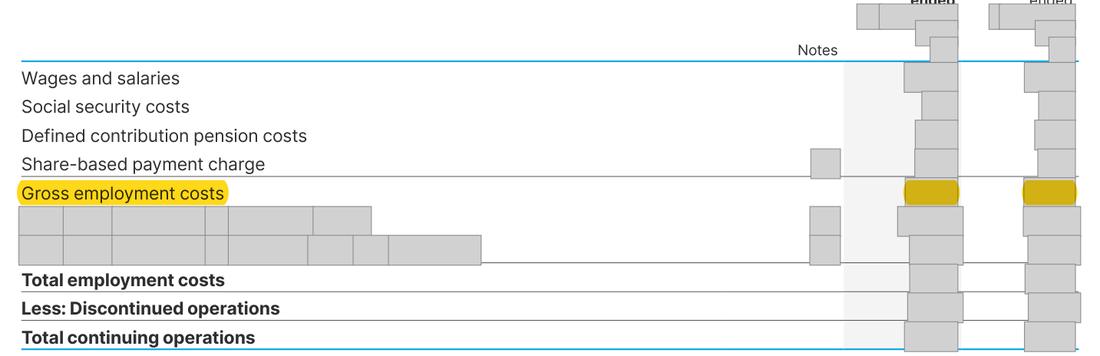
Further pages withheld to protect the company’s identity (two): Annual Report 2025, page 153; Annual Report 2024, page 141. Their wording or layout could lead back to the company even with names and figures masked; the evidence list below records what each page shows.
Names, figures, dates, logos and any wording that could be searched back to the company are boxed out in grey; the point is highlighted in yellow.
What the report shows, and what the rule requires
| What the annual report shows | What the rule requires |
|---|---|
| What the annual report shows p.153: (Loss) before tax from continuing operations ([n]) and ([n]); Total gross employee pay [n] and [n]; no difference in spend shown for either item (the 2024 table likewise) | What the rule requires A difference column for each item shown (pay: [n] - [n] = ([n]), a ([n])% change) |
What we checked: Relative importance of spend on pay table against Note 2.4, the whole-report text and the 2024 report's table (Annual Report [amount].141)
The rule
Large and Medium-sized Companies and Groups (Accounts and Reports) Regulations 2008 (SI 2008/410), Schedule 8, paragraph 20(1)
Version relied on: Large and Medium-sized Companies and Groups (Accounts and Reports) Regulations 2008 (SI 2008/410), in force from April 2008, as amended (the directors’ remuneration report Schedule 8 as substituted from October 2013); revised text, legislation.gov.uk
The directors’ remuneration report must set out in a graphical or tabular form that shows in respect of the relevant financial year and the immediately preceding financial year the actual expenditure of the company, and the difference in spend between those years, on— (a)remuneration paid to or receivable by all employees of the group
Why it applies here: paragraph 20(1) of Schedule 8 names 'the difference in spend between those years' as an item the table must show; the reader is left to work it out, in both years.
Why it matters
- A content item of Schedule 8 is missing from the remuneration report in both years; no amount is wrong.
- Shareholders have to work out the change in pay spend that the table exists to show.
A Schedule 8 content item is left out of the remuneration report in both years; no amount is wrong, and the reader has to work out the change in pay spend.
Exposure
No fine. Possible FRC Corporate Reporting Review comment; fixed by adding a difference column in the next report.
Our workings
the table on p.153 sets out the loss before tax from continuing operations, ([n]) and ([n]), and total gross employee pay for 2025 and 2024; it has no column or sentence giving the difference between the years, and no dividend or buyback was made in either year. Note 2.4 gives gross employment costs of [n] and [n]. The 2024 report's table had the same two-column layout.
the pay difference is [n] - [n] = ([n]), a ([n])% fall (workings).
| Item (£m) | 2025 | 2024 | Difference |
|---|---|---|---|
| Total gross employee pay | [n] | [n] | [n] - [n] = ([n]) |
| Change in pay, % | ([n]) / [n] = ([n])% |
Management’s best defence, and our reply
The Company would say the table sets the two years side by side, so the [amount] change in pay is visible at a glance, and that the regulation allows a graphical or tabular form without prescribing a change column. It would add that the difference is simple arithmetic on two printed figures and that no reader is misled about the direction or size of the change. However, paragraph 20(1) lists the difference in spend as something the table must show, separately from each year's expenditure, and both years' tables leave it to the reader to compute; the point is small but the requirement is explicit, which is why the card is kept short.
The fix
- Add a difference column (amount and percentage change) for each item in the table.
Evidence relied on
| # | What it shows | Type | Where |
|---|---|---|---|
| 1 | The table is presented as the relative importance of spend on pay disclosure for both years | Document | Annual Report 2025, page 153 |
| 2 | Loss before tax shown for each year, with no difference | Document | Annual Report 2025, page 153 |
| 3 | Pay shown for each year with no difference | Document | Annual Report 2025, page 153 |
| 4 | Note 2.4 gives [n] for 2024, the figure the table draws on | Document | Annual Report 2025, page 201 |
Absence check
- Document
- Annual Report 2025
- Where it would appear
- Relative importance of spend on pay
- What is missing
- the difference in spend between 2025 and 2024 for each item in the table
- Pages looked at
- p.152-154 (remuneration report: percentage change and relative importance tables) and Note [amount].201
- Result
- 'relative importance' and 'spend on pay' hit only the heading on p.153; 'difference in spend' has no hits; '[n]' hits p.25 and [n] (Letter of Credit revenue), [n] (market share), [n] (other comprehensive expense), [n] ([n] in note tables), none a pay difference; '([n])%' hits only a utilities cost change in the Financial Review table on p.37.
Prepared by Pramanex from the company’s published annual reports, without the company’s involvement, to show how an annual report review reads. The company is not named, and nothing on this page is a statement about any identifiable company. Observations are not an audit, review or other assurance engagement, and not legal advice. A regulator-style question is a question, not a conclusion.
Want this on your own annual report, before it is published?
Start with three free findings on your latest published annual report, or talk to us about a fixed-fee pre-publication review.
Your annual report will be in draft before the year-end audit.
Have it read before it is published.
Under NDA, with our reviewer on your insider list under UK MAR.