1.29 Tax credited to other comprehensive income is about half of the loss on equity investments, and in 2024 a loss carried a tax charge
UK Company B · a UK-listed technology and logistics group · Regulator-style question
In brief
The fair value loss on equity investments in other comprehensive income is [n], and the tax credited against it is [n], about 50% against a 25% UK rate. In 2024 a loss of [n] carried a tax charge of [n]. The deferred tax note books the credit to 'other short-term temporary differences', which include fair value of investments, but does not explain why the tax is out of line with the loss.
The evidence, as filed
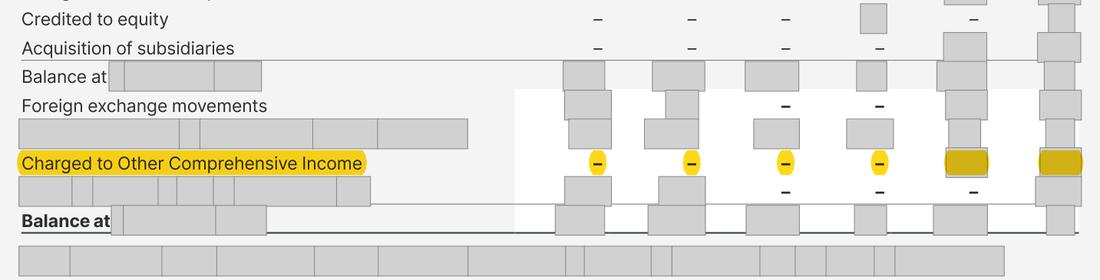
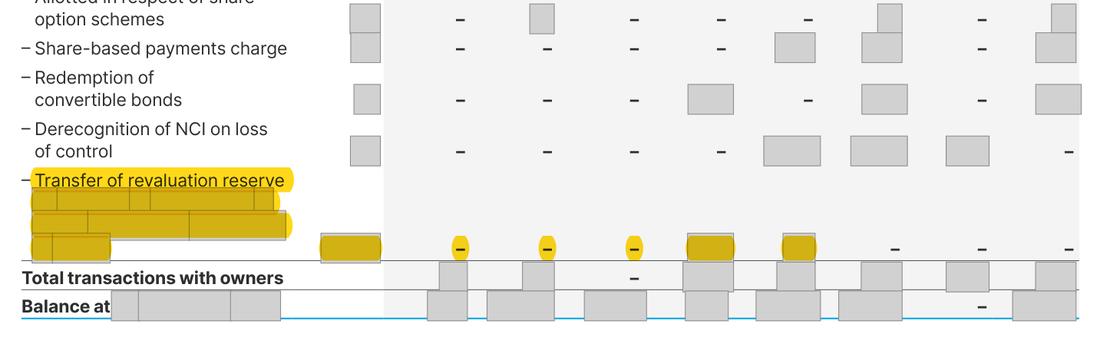
Further pages withheld to protect the company’s identity (three): Annual Report 2025, page 184; Annual Report 2024, page 167; Annual Report 2025, page 207. Their wording or layout could lead back to the company even with names and figures masked; the evidence list below records what each page shows.
Names, figures, dates, logos and any wording that could be searched back to the company are boxed out in grey; the point is highlighted in yellow.
What the report shows, and what the rule requires
| What the annual report shows | What the rule requires |
|---|---|
| What the annual report shows Statement of comprehensive income: loss on equity investments at fair value through other comprehensive income ([n]) (2024: ([n])); related income tax [n] (2024: ([n])). Deferred tax note: credited to other comprehensive income [n]; 2024 charged ([n]); deferred tax recognised at 25%. | What the rule requires A short explanation of the tax recognised in other comprehensive income where it departs from the 25% rate (for example the release of a deferred tax liability on investments sold or written down, or losses on investments that attract no relief). |
The rule
IAS 12 Income Taxes, paragraph 61A
Version relied on: UK-adopted international accounting standards (UK Endorsement Board), as in force for financial years beginning in or after January 2025
Tax on items recognised outside profit or loss is itself recognised outside profit or loss.
Why it applies here: the pattern can arise if a deferred tax liability set up on earlier fair value gains is released when investments are written down or sold (the statement of changes in equity shows a [n] [wording masked]), or if some losses attract no relief while other gains are taxed.
Why it matters
Without an explanation a reader cannot tell whether the tax credited to equity is a reversal of earlier tax or a new benefit, or check that it is recorded in the right place.
Exposure
No regulatory consequence expected; an explanation in the next report.
Our workings
the statement of comprehensive income shows a loss on equity investments at fair value through other comprehensive income of [n] (2024: [n]) and income tax on items not reclassified of [n] credit (2024: [n] charge). The deferred tax note records [n] credited to other short-term temporary differences, which include the fair value of investments, and [n] charged in share-based payments, and says deferred tax is recognised at 25%.
[n] x 25% = [n], so the credit exceeds the rate-based amount by [n] and equals 50% of the loss; in 2024 a 25% credit of [n] would be expected on a [n] loss, but a charge of [n] was booked.
The note does not say which, so a reader cannot check the line.
| Measure | Computation | Result |
|---|---|---|
| Tax at 25% on the 2025 loss | [n] x 25% = [n]; [n] - [n] = [n] | credit exceeds the rate-based amount by [n] |
| Effective rate on the 2025 loss | [n] / [n] = 50% | 50% |
| Tax at 25% on the 2024 loss | [n] x 25% = [n] credit expected; [n] charge booked | opposite direction |
Management’s best defence, and our reply
Management would say the tax in other comprehensive income follows the deferred tax previously recognised on each investment, so a release on disposal or write-down naturally produces a credit larger than 25% of the current-year loss. They would add that IAS 12 asks for the tax on each component of other comprehensive income, which is given, and not a rate reconciliation for it. That is a reasonable position, which is why the point is a question; however, a credit of twice the rate-based amount in one year and a charge on a loss in the other year call for a sentence of explanation.
The fix
- Add one sentence to the deferred tax note: 'The [n] credit to other comprehensive income comprises [n] at 25% on fair value losses and [n] release of deferred tax previously recognised on investments disposed of' (or the actual analysis).
Question for the company
The tax credited to other comprehensive income in 2025 ([n]) is about half of the [n] loss on equity investments, against a 25% rate, and in 2024 a loss of [n] carried a tax charge of [n]. What makes up these amounts (for example a release of deferred tax on investments sold or written down, or losses that attract no relief), and could the 2026 report explain the tax on other comprehensive income where it departs from the standard rate?
Evidence relied on
| # | What it shows | Type | Where |
|---|---|---|---|
| 1 | OCI loss on equity investments of [n] (2024: [n]) | Document | Annual Report 2025, page 184 |
| 2 | Tax credit of [n] in 2025 and a charge of [n] in 2024 on those items | Document | Annual Report 2025, page 184 |
| 3 | The deferred tax note books [n] to other short-term differences and [n] to share-based payments | Document | Annual Report 2025, page 207 |
| 4 | The category includes fair value of investments | Document | Annual Report 2025, page 207 |
| 5 | Investments at fair value through OCI were disposed of in the year (reserve transfer of [n]) | Document | Annual Report 2025, page 187 |
| 6 | 2024 and 2023: losses of [n] and [n] on equity investments in other comprehensive income | Document | Annual Report 2024, page 167 |
| 7 | 2024 and 2023: a tax charge, not a credit, against those losses | Document | Annual Report 2024, page 167 |
| 8 | The 2024 charge sits in the deferred tax on other temporary differences, including fair value of investments | Document | Annual Report 2024, page 186 |
Prepared by Pramanex from the company’s published annual reports, without the company’s involvement, to show how an annual report review reads. The company is not named, and nothing on this page is a statement about any identifiable company. Observations are not an audit, review or other assurance engagement, and not legal advice. A regulator-style question is a question, not a conclusion.
Want this on your own annual report, before it is published?
Start with three free findings on your latest published annual report, or talk to us about a fixed-fee pre-publication review.
Your annual report will be in draft before the year-end audit.
Have it read before it is published.
Under NDA, with our reviewer on your insider list under UK MAR.