1.22 The 2024 revenue from major customers in [segment] is [n] in this report but [n] in the 2024 report
UK Company B · a UK-listed technology and logistics group · Regulator-style question
In brief
This year's segment note gives 2024 revenue from major customers in the [segment] segment as [n]. The 2024 report gave the same year's figure as [n]. The difference of [n] is not explained, and the [segment] comparative ([n] against [n]) is unchanged apart from rounding.
The evidence, as filed
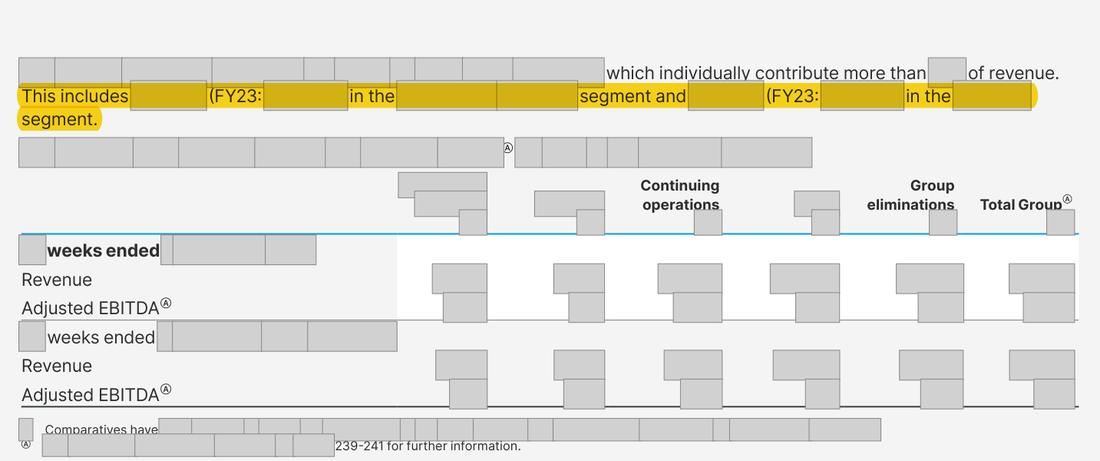
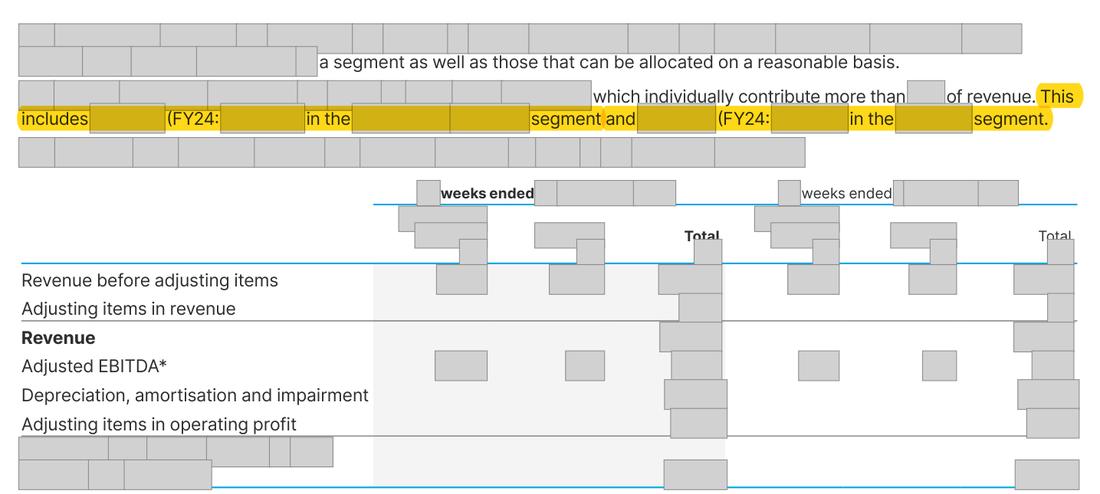
Names, figures, dates, logos and any wording that could be searched back to the company are boxed out in grey; the point is highlighted in yellow.
What the report shows, and what the rule requires
| What the annual report shows | What the rule requires |
|---|---|
| What the annual report shows 2025 report: [segment] major-customer revenue 'FY24: [amount]'. 2024 report: [n] for the same year. No restatement note. | What the rule requires Either the comparative as published, or a short note explaining why the 2024 figure changed (for example a different set of customers above 10% this year, or the inclusion of a customer's revenue previously excluded). |
The rule
IAS 1 Presentation of Financial Statements, paragraph 38
Version relied on: UK-adopted international accounting standards (UK Endorsement Board), as in force for financial years beginning in or after January 2025
Every amount in the current-year accounts needs a prior-year comparative.
Why it applies here: possible reasons include a change in which customers exceed the 10% threshold (the comparative then shows this year's major customers' revenue in 2024), or a change in how revenue from [former subsidiary], a related party after [date], is treated.
Why it matters
Without an explanation a reader comparing the two reports cannot tell whether customer concentration in [segment] grew by [n]% or by [n]% in 2025.
Exposure
No regulatory consequence expected; an explanation in the next report.
Our workings
Note 2.2 of the 2025 report gives revenue from the three major customers in [segment] with a 2024 comparative of [n]. The 2024 report gave [n] for 2024 in the same sentence. The [segment] comparative is [n] against [n] published.
[n] - [n] = [n].
Neither is stated, so the reader cannot tell whether the 2024 figure was corrected or simply re-based.
| Measure | Computation | Result |
|---|---|---|
| Change in the 2024 [segment] figure | [n] - [n] = [n] | [n] |
| Change in the 2024 [segment] figure | [n] - [n] = -[n] | rounding |
Management’s best defence, and our reply
Management would say the comparative correctly shows 2024 revenue from the customers that are major customers in 2025, which is the comparison a reader needs, and that the 2024 report showed a different set of customers. On that reading both the 2024 report and the 2025 comparative are right for the customer set each describes, and nothing has been restated. That defence is reasonable, which is why this is put as a question; however, IAS 1 expects a reclassified comparative to be explained, and the note says nothing about the change.
The fix
- Add a footnote: 'The FY24 comparative has been re-presented to show revenue from the customers that exceed 10% of revenue in FY25' (or the actual reason), and give per-customer amounts.
Question for the company
The 2024 comparative for revenue from major customers in [segment] is [n] in the 2025 report but was [n] in the 2024 report. What explains the [n] difference: a change in which customers exceed 10% of revenue, a change in how revenue from [former subsidiary] is treated, or a correction? Could the 2026 report give the per-customer amounts for both years with a note on any re-basing?
Evidence relied on
| # | What it shows | Type | Where |
|---|---|---|---|
| 1 | The 2025 report gives the 2024 [segment] major-customer revenue as [n] | Document | Annual Report 2025, page 199 |
| 2 | The [segment] comparative is [n] | Document | Annual Report 2025, page 199 |
| 3 | The 2024 report gave [n] ([segment]) and [n] ([segment]) for 2024 | Document | Annual Report 2024, page 179 |
Prepared by Pramanex from the company’s published annual reports, without the company’s involvement, to show how an annual report review reads. The company is not named, and nothing on this page is a statement about any identifiable company. Observations are not an audit, review or other assurance engagement, and not legal advice. A regulator-style question is a question, not a conclusion.
Want this on your own annual report, before it is published?
Start with three free findings on your latest published annual report, or talk to us about a fixed-fee pre-publication review.
Your annual report will be in draft before the year-end audit.
Have it read before it is published.
Under NDA, with our reviewer on your insider list under UK MAR.