7.12 Board change dates differ across the 2024 governance and remuneration pages
UK Company A · a UK-listed medical technology group · Drafting slip
In brief
The report gives different dates for the same Board changes. The new Chief Financial Officer (CFO) is said to have joined the Board on [date] on two pages and on [date] in the service contract table. The former CFO is said to have stepped down on [date] in the attendance table note but on [date] elsewhere, and a Non-Executive Director who retired is given [date] in one note and [date] in another. The fee table note says the Chair joined in [date], when he joined the Board in [date] and became Chair in September.
The evidence, as filed
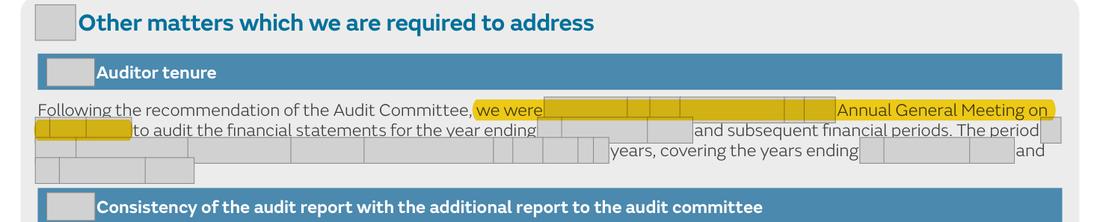

Further pages withheld to protect the company’s identity (seven): Annual Report 2024, page 121; Annual Report 2025, page 127; Annual Report 2024, page 139; Annual Report 2025, page 107; Annual Report 2024, page 152; Annual Report 2024, page 103; Annual Report 2024, page 145. Their wording or layout could lead back to the company even with names and figures masked; the evidence list below records what each page shows.
Names, figures, dates, logos and any wording that could be searched back to the company are boxed out in grey; the point is highlighted in yellow.
What the report shows, and what the rule requires
| What the annual report shows | What the rule requires |
|---|---|
| What the annual report shows New CFO: [date] (p.121 and p.139) and [date]. Former CFO: [date] and [date] (other pages). Retiring Non-Executive Director: [date] and [date]. Chair: 'joined in [date]' against [date] Board appointment. | What the rule requires One set of dates throughout: new CFO appointed [date]; former CFO stepped down [date]; retiring Non-Executive Director left the Board on [date]; Chair joined the Board on [date] and became Chair on [date] (dates as printed in the audited remuneration tables and the service contract table). |
What we checked: Every statement of these Board changes in the governance section and the directors' remuneration report, read on the page images; the public register of officers gives the same dates as the service contract table and remuneration tables.
Why it matters
Readers cannot tell from the report which dates are right; the inconsistency sits in pages the auditor reviews for consistency with the audited remuneration tables.
Exposure
Drafting only.
Our workings
These are date slips in narrative notes; no remuneration figure depends on them, because the single figure table runs the new CFO's pay from [date]. The service contract table and the audited remuneration notes give the dates that the public register of officers also shows; the skills matrix note, the Chair's letter, the attendance table note and the fee table note each give a different day for the same event.
Management’s best defence, and our reply
The company could say the changes happened at a month-end handover, so [date] and [date] describe the same transition, and that a director leaving at the [date] AGM can be described either way. However, the report itself gives a single date in its service contract table and audited notes, and the narrative notes should match them.
The fix
- Use the service contract and audited-table dates throughout: "appointed to the Board on [date]"; "stepped down from the Board on [date]"; "stepped down from the Board on [date]"; "joined the Board in [date] and became Chair in [date]".
Evidence relied on
| # | What it shows | Type | Where |
|---|---|---|---|
| 1 | Skills matrix note: new CFO from [date] | Document | Annual Report 2024, page 121 |
| 2 | Chair's letter: new CFO appointed to the Board on [date] | Document | Annual Report 2024, page 139 |
| 3 | Service contract table: new CFO appointed as director on [date] | Document | Annual Report 2024, page 152 |
| 4 | Attendance table note: former CFO left on [date]; retiring Non-Executive Director left on [date] | Document | Annual Report 2024, page 103 |
| 5 | Skills matrix note: the same Non-Executive Director left on [date] | Document | Annual Report 2024, page 121 |
| 6 | Fee table note: the Chair 'joined in [date]' | Document | Annual Report 2024, page 145 |
| 7 | Audited fee table note: joined the Board [date], Chair from [date] | Document | Annual Report 2024, page 164 |
| 8 | Nomination & Governance Committee Report dates the departure to the 2025 AGM | Document | Annual Report 2025, page 127 |
| 9 | Board pages (and the attendance, tenure and remuneration footnotes) date it to [date] | Document | Annual Report 2025, page 107 |
| 10 | The auditor's report dates the 2025 AGM to [date], the day after the [date] departure | Document | Annual Report 2025, page 210 |
Prepared by Pramanex from the company’s published annual reports, without the company’s involvement, to show how an annual report review reads. The company is not named, and nothing on this page is a statement about any identifiable company. Observations are not an audit, review or other assurance engagement, and not legal advice. A regulator-style question is a question, not a conclusion.
Want this on your own annual report, before it is published?
Start with three free findings on your latest published annual report, or talk to us about a fixed-fee pre-publication review.
Your annual report will be in draft before the year-end audit.
Have it read before it is published.
Under NDA, with our reviewer on your insider list under UK MAR.