5.04 Average employee numbers are given only as a single total, not by the categories the Companies Act requires
UK Company A · a UK-listed medical technology group · Compliance or disclosure gap
In brief
Note 3.1 gives one average headcount for the group ([n] in 2025; [n] in 2024). Section 411(1A) of the Companies Act 2006 requires a company that is not small to give the average number within each category of employees, with categories chosen by the directors to reflect how the business is organised; for group accounts the group is treated as one company. No split by category appears anywhere in either report.
The evidence, as filed
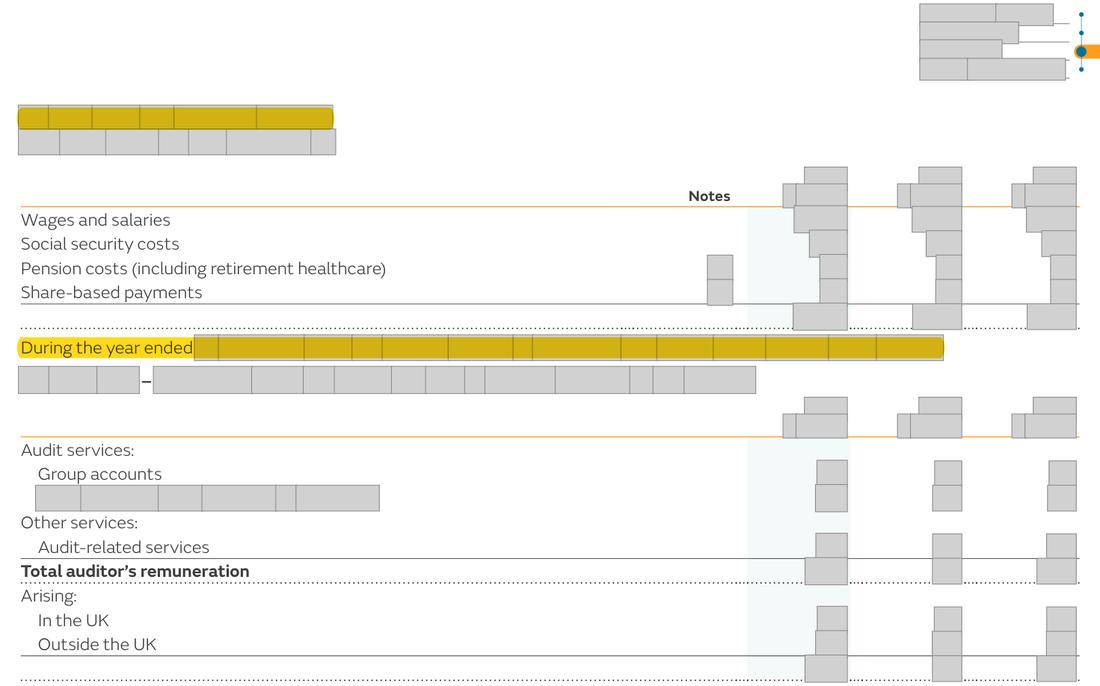
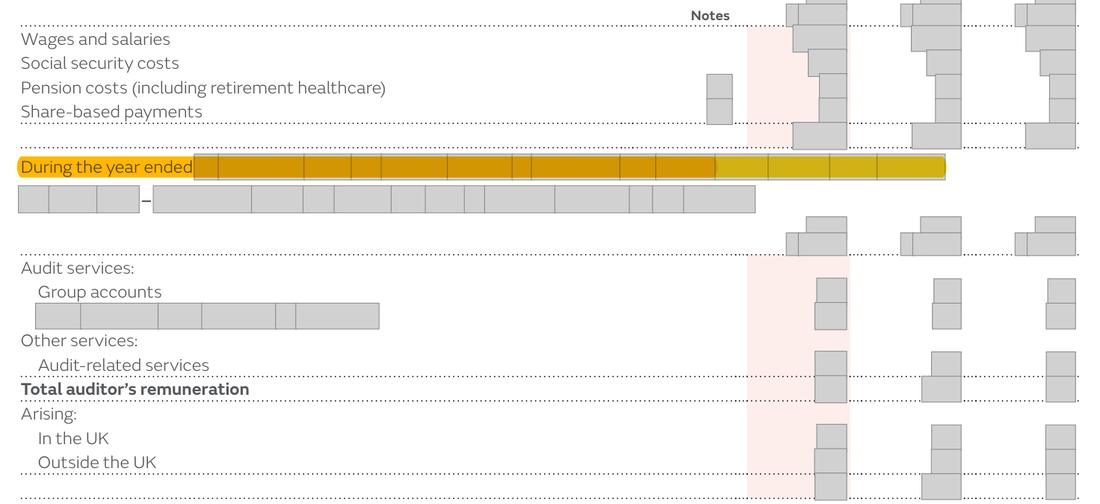
Names, figures, dates, logos and any wording that could be searched back to the company are boxed out in grey; the point is highlighted in yellow.
What the report shows, and what the rule requires
| What the annual report shows | What the rule requires |
|---|---|
| What the annual report shows Note 3.1: '[wording masked] [n] (2024: [n], 2023: [n])', one total in both years; no category analysis anywhere in the report. | What the rule requires The average number of employees in each category chosen by the directors (for example by business unit or by function - manufacturing, sales and marketing, research and development, administration), for 2025 and 2024. |
What we checked: Read Note 3.1 in both reports and searched the whole 2025 report for any category split of headcount.
The rule
Companies Act 2006 s.411(1A)
Version relied on: Companies Act 2006, revised text on legislation.gov.uk as in force for the financial year reviewed
In the case of a company not subject to the small companies regime, the notes to the company’s accounts must also disclose the average number of persons within each category of persons so employed.
Companies Act 2006 s.411(7)
Version relied on: Companies Act 2006, revised text on legislation.gov.uk as in force for the financial year reviewed
This section applies in relation to group accounts as if the undertakings included in the consolidation were a single company.
Why it applies here: Statutory category analysis absent in both years.
Why it matters
- Readers cannot see how the fall from [n] to [n] employees spreads across the business.
- A narrow statutory note, which is why the priority is low.
The statutory category analysis is missing from both years' accounts; readers cannot see how the workforce reduction from [n] to [n] falls across the business.
Exposure
A disclosure omission of this kind would normally be dealt with by an FRC letter and correction in the next report; no fine applies to the omission itself.
Our workings
the only employee number in the accounts is the group average of [n] (2024: [n]), given as one figure in Note 3.1; the 2024 note gives the same single-figure form. The climate pages repeat the total as an intensity denominator.
section 411 sets two separate requirements. Subsection (1) asks for the average number employed; subsection (1A), inserted for financial years from 2016 for companies outside the small companies regime, adds the average number within each category, and subsection (2) leaves the choice of categories to the directors 'having regard to the manner in which the company's activities are organised'. Subsection (7) applies the section to group accounts as if the undertakings in the consolidation were a single company, so the group note must carry the category split. The grey area is whether directors may choose a single category; that reading empties subsection (1A) of meaning ('each category' presupposes more than one where the activities are organised in more than one way), and the group itself reports three business units and separate manufacturing, commercial and research functions. The requirement is statutory and has no materiality threshold of its own; the omission is a small one in practice, which is why the severity is low.
Management’s best defence, and our reply
Management would say that section 411(2) leaves the categories to the directors and that, for a group managed globally, a single total is the category that reflects how the business is organised. They would add that the number is immaterial to any economic decision and that headcount detail appears in the sustainability report. However, 'each category' in subsection (1A) assumes a split where the activities are organised in more than one way, and this group reports three business units and distinct manufacturing, commercial and research functions; the sustainability report is not part of the annual accounts in which the section requires the disclosure.
The fix
- Add to Note 3.1 a table of average employee numbers by category (for example: Manufacturing and supply; Sales and marketing; Research and development; Administration), with the comparative.
Evidence relied on
| # | What it shows | Type | Where |
|---|---|---|---|
| 1 | The only employee number in the 2025 accounts: one group total | Document | Annual Report 2025, page 223 |
| 2 | The 2024 accounts give the same single total | Document | Annual Report 2024, page 205 |
Absence check
- Document
- Annual Report 2025
- Where it would appear
- [n] Staff costs and employee numbers
- What is missing
- the average number of employees within each category chosen by the directors
- Pages looked at
- p.60-66 (people), [n], 268-275
- Result
- 'average number' hits p.223 (the single group total) and p.227 and [n] (weighted average number of shares); 'headcount' hits p.33 (narrative on reducing headcount) and p.154 (remuneration peer-group chart); 'full-time employee' hits p.77 (the same [n] total used as a climate intensity denominator). 'by function' and 'employees by' have no hits.
Prepared by Pramanex from the company’s published annual reports, without the company’s involvement, to show how an annual report review reads. The company is not named, and nothing on this page is a statement about any identifiable company. Observations are not an audit, review or other assurance engagement, and not legal advice. A regulator-style question is a question, not a conclusion.
Want this on your own annual report, before it is published?
Start with three free findings on your latest published annual report, or talk to us about a fixed-fee pre-publication review.
Your annual report will be in draft before the year-end audit.
Have it read before it is published.
Under NDA, with our reviewer on your insider list under UK MAR.