4.07 [business unit] 2024 growth: the business unit review gives growth rates on a mixed basis that the alternative performance measure reconciliation does not support, and two different underlying growth figures
UK Company A · a UK-listed medical technology group · Presentation point
In brief
The [business unit] performance table recalculates 2024 growth using 2024 revenue after [product line] consumables were moved out of [business unit], but measures it against 2023 revenue that was not moved: [business unit] [n]% reported and [n]% underlying, [business unit] negative [n]% reported and negative [n]% underlying, and [business unit] underlying growth of [n]%. Its footnote says these alternative performance measures (APMs) are reconciled on pages 285-292, but the reconciliation there still shows the 2024 figures as first published: [business unit] [n]% and [n]%, [business unit] [n]% and [n]%, [business unit] underlying [n]%. The Financial review also gives [n]%, and the next page of the review says [business unit] grew double digit in 2024.
The evidence, as filed
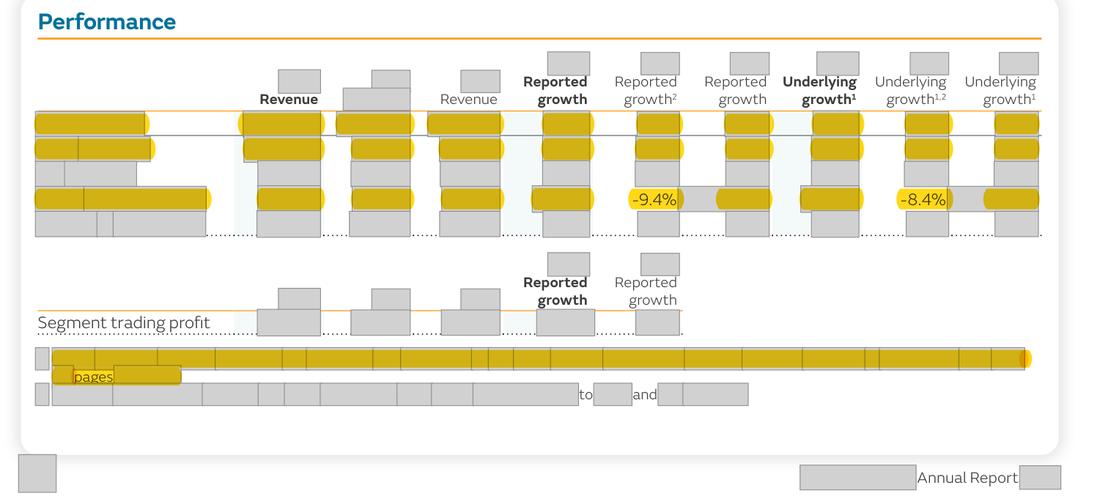
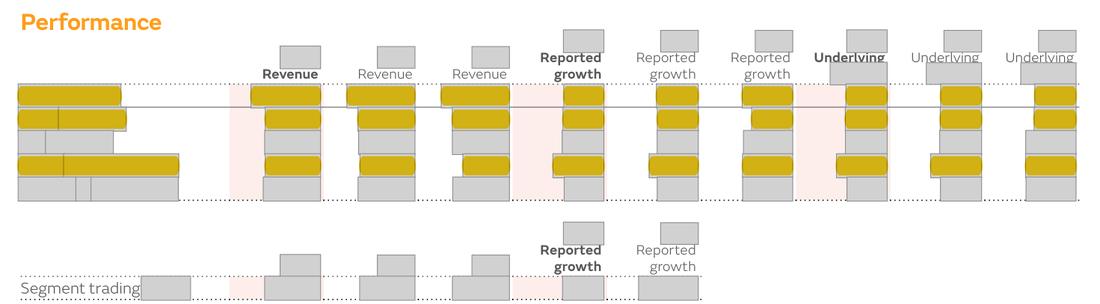
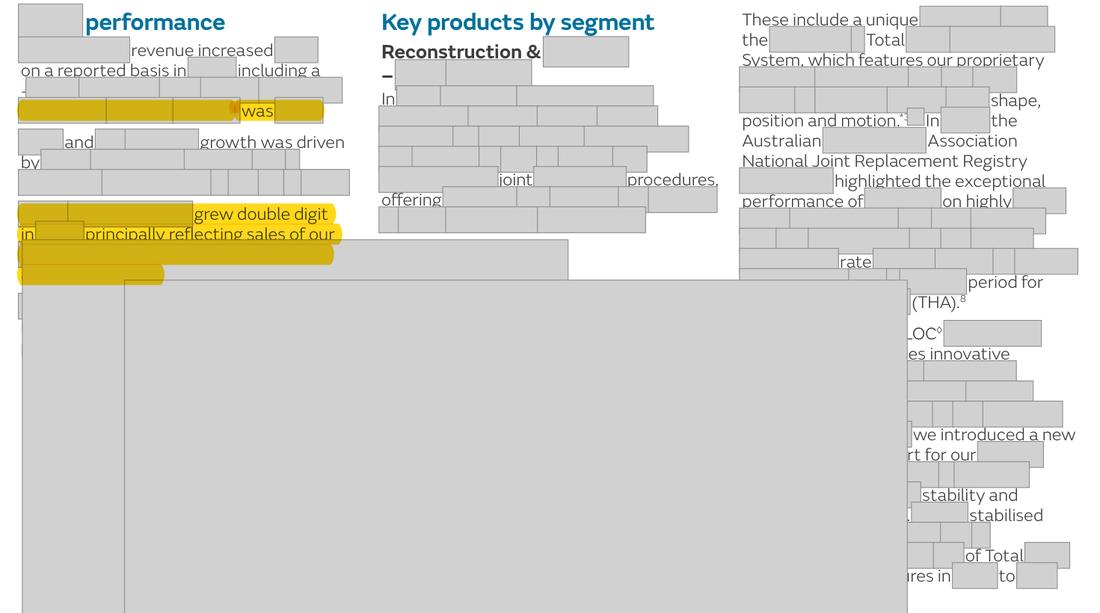
Further pages withheld to protect the company’s identity (two): Annual Report 2025, page 288; Annual Report 2025, page 20. Their wording or layout could lead back to the company even with names and figures masked; the evidence list below records what each page shows.
Names, figures, dates, logos and any wording that could be searched back to the company are boxed out in grey; the point is highlighted in yellow.
What the report shows, and what the rule requires
| What the annual report shows | What the rule requires |
|---|---|
| What the annual report shows [business unit] review: 2024 [business unit] underlying growth [n]%; [business unit] [n]% / [n]%; [business unit] negative [n]% / negative [n]%, computed on moved 2024 revenue against unmoved 2023 revenue; text: [business unit] grew double digit in 2024. Reconciliation and Financial review: [business unit] underlying [n]%; [business unit] [n]% / [n]%; [business unit] [n]% / [n]%. | What the rule requires One set of 2024 growth rates across the report, each computed with both years on the same product grouping (or the published rates kept), reconciled on the pages the footnote cites, with a short note of the reclassification's effect. [business unit] growth in total is unaffected by a move between its own lines and should read the same everywhere. |
The rule
ESMA Guidelines on Alternative Performance Measures, paragraph 38 (comparatives)
Version relied on: ESMA Guidelines on Alternative Performance Measures, ESMA/2015/1415, published October 2015, applying from July 2016; the FCA expects UK issuers to continue to apply them after EU exit
Issuers or persons responsible for the prospectus should present reconciliations for all comparatives presented.
FCA, Brexit: our approach to EU non-legislative materials, paragraph 11(i)
Version relied on: FCA statement on EU non-legislative materials (Brexit), applying from the end of the transition period, December 2020
we expect firms and market participants to continue to apply the Guidelines to the extent that they remain relevant
Why it applies here: the review's 2024 line rates include the reclassification as if it were trading (the [business unit] 'decline' comes from the move, not from sales), they have no bridge to IFRS revenue growth on the reconciliation pages the footnote cites, and the double-digit narrative, which agrees with the published basis, sits beside a table showing a fall.
Why it matters
A reader comparing the business unit review with the reconciliation pages it cites finds two sets of 2024 growth rates, no bridge for the review's set, and reads a double-digit rise in [business unit] next to a table showing a fall that comes from the reclassification. [business unit] underlying growth for 2024 is given as both [n]% and [n]%.
Exposure
No fine or enforcement is realistic for an inconsistency in voluntary measures; the realistic outcome is a question from the FRC Corporate Reporting Review on the consistency of APMs if the report is reviewed.
Our workings
the 2025 report moved [product line] consumables revenue from [business unit] to [product] and [business unit] for the 2024 comparative only ([business unit] [amount] against [amount] published; [business unit] [amount] against [amount]), while 2023 stays as published ([business unit] [amount], [business unit] [amount]). The [business unit] table on p.40 recalculates the 2024 growth rates on that mixed basis and cites pages 285-292 for their reconciliation. The reconciliation on p.288 reproduces the 2024 table exactly as published in the 2024 report.
moved 2024 against unmoved 2023 gives [business unit] [n] / [n] - 1 = [n]% and [business unit] [n] / [n] - 1 = -[n]% (negative [n]% printed, within the rounding of [currency]m figures); on the published revenue, [n] / [n] - 1 = [n]% and [n] / [n] - 1 = [n]%. [business unit] revenue in total is the same on both bases ([amount] against [amount]), so its underlying growth cannot change with the reclassification, yet it reads [n]% on p.40 and p.41 and [n]% on p.20, p.288 and in the 2024 report.
A reconciliation is expected for every APM comparative presented.
| Measure (2024) | [business unit] review p.40-41 | Reconciliation p.288 / Financial review p.20 |
|---|---|---|
| [business unit] reported growth | [n]%: [n] / [n] - 1 = [n]% (moved 2024 on unmoved 2023) | [n]%: [n] / [n] - 1 = [n]% (published basis) |
| [business unit] reported growth | -[n]%: [n] / [n] - 1 = -[n]% (moved 2024 on unmoved 2023) | [n]%: [n] / [n] - 1 = [n]% (published basis) |
| [business unit] growth (total unaffected by the move) | reported [n] / [n] - 1 = [n]%; underlying [n]% | reported [n]%; underlying [n]% (also the 2024 report) |
Management’s best defence, and our reply
The company would say the reconciliation on p.288 deliberately reproduces the 2024 reconciliation as published, and that the restated [product], [product] and [business unit] rates on p.40 follow mechanically from the revenue reclassification disclosed in the footnote and in Note 2, so a reader can see why they differ. It would add that the [n]-point difference in [business unit] underlying growth is a rounding matter. However, the footnote on p.40 points to pages 285-292 for the reconciliation of the very rates shown, and those pages reconcile different rates; and the reclassification is inside [business unit], so it cannot move [business unit] growth in total from [n]% to [n]% - the company published [n]% for the same year and repeats it on p.20 and p.288. The narrative of double-digit growth also cannot stand beside a restated decline.
The fix
- In the 2026 report, compute prior-year growth with both years on the same product grouping, reconcile any restated business-line growth on the reconciliation pages, explain the reclassification's effect on prior-year growth, keep the narrative and the table on one basis, and use one figure for [business unit] underlying growth.
Evidence relied on
| # | What it shows | Type | Where |
|---|---|---|---|
| 1 | [business unit] table: 2024 underlying growth [n]%; 2024 and 2023 revenue [amounts] | Document | Annual Report 2025, page 40 |
| 2 | [business unit]: reclassified 2024 revenue [amount], 2024 growth [n]% reported and [n]% underlying | Document | Annual Report 2025, page 40 |
| 3 | [business unit]: reclassified 2024 revenue [amount]; 2024 growth printed -[n]% reported and -[n]% underlying | Document | Annual Report 2025, page 40 |
| 4 | Footnote 1 sends the reader to pages 285-292 for the reconciliation of these growth rates | Document | Annual Report 2025, page 40 |
| 5 | 2024 performance text repeats [business unit] underlying growth of [n]% | Document | Annual Report 2025, page 41 |
| 6 | Narrative still describes double-digit 2024 growth (and includes consumables) against the table's 2024 decline, which comes from the reclassification | Document | Annual Report 2025, page 41 |
| 7 | Reconciliation of 2024 growth: [business unit] underlying [n]% | Document | Annual Report 2025, page 288 |
| 8 | Reconciliation of 2024 growth: [business unit] [n]% reported and [n]% underlying (published basis) | Document | Annual Report 2025, page 288 |
| 9 | Reconciliation of 2024 growth: [business unit] [n]% reported and [n]% underlying (published basis) | Document | Annual Report 2025, page 288 |
| 10 | Financial review gives [business unit] 2024 underlying growth as [n]% | Document | Annual Report 2025, page 20 |
| 11 | 2024 report as published: [business unit] 2024 underlying growth [n]% | Document | Annual Report 2024, page 40 |
| 12 | 2024 report as published: [business unit] 2024 revenue [amount], growth [n]% / [n]% | Document | Annual Report 2024, page 40 |
| 13 | 2024 report as published: [business unit] 2024 revenue [amount], growth [n]% / [n]% | Document | Annual Report 2024, page 40 |
Prepared by Pramanex from the company’s published annual reports, without the company’s involvement, to show how an annual report review reads. The company is not named, and nothing on this page is a statement about any identifiable company. Observations are not an audit, review or other assurance engagement, and not legal advice. A regulator-style question is a question, not a conclusion.
Want this on your own annual report, before it is published?
Start with three free findings on your latest published annual report, or talk to us about a fixed-fee pre-publication review.
Your annual report will be in draft before the year-end audit.
Have it read before it is published.
Under NDA, with our reviewer on your insider list under UK MAR.