1.21 Hedging instruments: the 2023 forward-contract row appears to include currency swaps that the note says are not hedge-accounted
UK Company A · a UK-listed medical technology group · Regulator-style question
In brief
The hedging-instrument table gives 2023 forward exchange contracts a nominal amount of [n] and carrying amounts of [n] (assets) and ([n]) (liabilities), in $ million. The 2023 fair value table shows forward contracts at [n] and ([n]) and currency swaps at 2 and (3); [n] + 2 = [n] and [n] + 3 = [n]. The narrative gives the 2023 contracted amount as [amount], while [n] is the 2023 maturity-table outflow for currency swaps and forward contracts together. The 2023 credit-risk figure of [amount] also sits below the debit fair values of [n] + 7 + 2 = [n].
The evidence, as filed
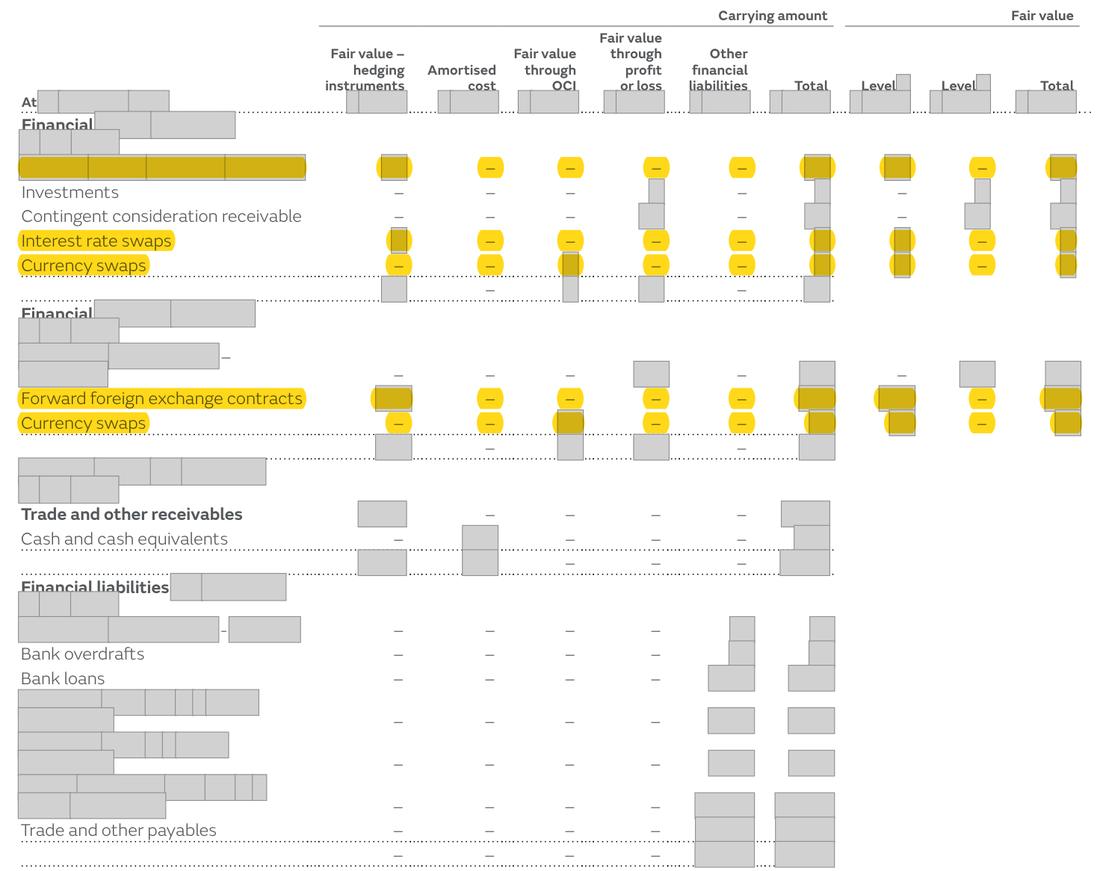
Further pages withheld to protect the company’s identity (three): Annual Report 2024, page 225; Annual Report 2024, page 224; Annual Report 2024, page 223. Their wording or layout could lead back to the company even with names and figures masked; the evidence list below records what each page shows.
Names, figures, dates, logos and any wording that could be searched back to the company are boxed out in grey; the point is highlighted in yellow.
What the report shows, and what the rule requires
| What the annual report shows | What the rule requires |
|---|---|
| What the annual report shows 2023 row: Forward exchange contracts, nominal [n], carrying amount assets [n], liabilities ([n]); maximum credit risk on derivatives 2023: [amount]; narrative: contracted to exchange [amount] (2023: [amount]). | What the rule requires If currency swaps were not hedge-accounted in 2023, the 2023 row would show forward contracts only ([n] and ([n]), nominal about [amount]) and the credit-risk figure would be the total debit fair values; if some swaps were designated, the table would show them as a separate hedging instrument and the narrative would match. |
The rule
IFRS 7 Financial Instruments: Disclosures, paragraph 24A(a) and (d)
Version relied on: UK-adopted international accounting standards (UK Endorsement Board), as in force for financial years beginning in or after January 2025
For hedging instruments, the accounts must give in a table, by risk category and type of hedge, the carrying amounts and other specified amounts.
IFRS 7 Financial Instruments: Disclosures, paragraph 36(a)
Version relied on: UK-adopted international accounting standards (UK Endorsement Board), as in force for financial years beginning in or after January 2025
The accounts must state the amount that best represents the maximum exposure to credit risk at the year end, before collateral or other credit enhancements.
Why it applies here: the 2023 comparative appears to combine currency swaps with the designated forward contracts.
Why it matters
A reader comparing the two years sees the nominal of designated forward contracts fall from [n] to [n] while the narrative says [amount] in both years, and cannot tell which instruments were in hedge relationships at the end of 2023.
Exposure
A comparative-year disclosure question; no penalty exposure.
Our workings
Note 16.2 gives the 2023 forward exchange contracts row as nominal [n], assets [n] and liabilities ([n]). The 2023 fair value table shows forward foreign exchange contracts of [n] and ([n]), currency swaps of 2 and (3) and interest rate swaps of 7. Note 16.1 gives the contracted amount as [amount] for both years and says hedge accounting is not applied to currency swaps; the 2023 maturity table has one outflow line of [n] for currency swaps and forward contracts together. For 2024 the same row (nominal [n]) agrees with the narrative.
[n] + 2 = [n] and [n] + 3 = [n], so the 2023 carrying amounts equal forwards plus currency swaps; debit fair values [n] + 7 + 2 = [n] against the [amount] credit-risk figure.
The 2023 report is not held, so the 2023 designation cannot be confirmed; the point is a question.
| Item at [date] ($ million) | Hedging table / narrative as printed | From the fair value and maturity tables | Difference |
|---|---|---|---|
| Carrying amount, assets | [n] | forwards [n] + currency swaps 2 = [n] | [n] - [n] = 2 |
| Carrying amount, liabilities | [n] | forwards [n] + currency swaps 3 = [n] | [n] - [n] = 3 |
| Nominal amount | [n] (table); [n] (narrative [amount]) | maturity outflow, currency swaps and forwards combined: [n] | [n] - [n] = [n] |
| Maximum credit risk, derivatives | [n] | debit fair values [n] + 7 + 2 = [n] | [n] - [n] = 7 |
Management’s best defence, and our reply
The company could say that some currency swaps were in hedge relationships in 2023: the 2023 fair value table places currency swaps in the fair value through other comprehensive income column, which is consistent with hedge accounting, so including them in the hedging row may be right. It could add that the [amount] narrative refers to forward contracts alone and that the carrying-amount differences of 2 and 3 are immaterial.
The fix
- Confirm the 2023 designation; if currency swaps were not designated, present the 2023 row for forward contracts only and state the 2023 credit-risk figure as the total debit fair values, or explain the basis.
Question for the company
At [date], did the forward exchange contracts row of the hedging-instrument table (nominal [n]; carrying amounts [n] and [n]) include currency swaps; which of [amounts] was the nominal amount of forward contracts designated as cash flow hedges; and does the 2023 maximum credit-risk exposure on derivatives of [amount] include the interest rate swap asset of 7?
Evidence relied on
| # | What it shows | Type | Where |
|---|---|---|---|
| 1 | 2023 hedging-instrument row: nominal [n], carrying assets [n], liabilities ([n]) | Document | Annual Report 2024, page 225 |
| 2 | 2024 row for comparison: nominal [n], which matches the [amount] narrative | Document | Annual Report 2024, page 225 |
| 3 | 2023 credit-risk figure of [amount], defined as total debit fair values of all three derivative types | Document | Annual Report 2024, page 225 |
| 4 | The narrative gives [amount] for 2023, not [amount] | Document | Annual Report 2024, page 224 |
| 5 | The note says currency swaps are not hedge-accounted | Document | Annual Report 2024, page 224 |
| 6 | 2023 maturity table: [n] is the outflow for currency swaps and forward contracts combined | Document | Annual Report 2024, page 223 |
| 7 | 2023 fair value table: forward contracts asset [n] | Document | Annual Report 2024, page 229 |
| 8 | 2023 fair value table: interest rate swap asset 7 | Document | Annual Report 2024, page 229 |
| 9 | 2023 fair value table: currency swap asset 2 | Document | Annual Report 2024, page 229 |
| 10 | 2023 fair value table: forward contracts liability ([n]) | Document | Annual Report 2024, page 229 |
| 11 | 2023 fair value table: currency swap liability (3) | Document | Annual Report 2024, page 229 |
Prepared by Pramanex from the company’s published annual reports, without the company’s involvement, to show how an annual report review reads. The company is not named, and nothing on this page is a statement about any identifiable company. Observations are not an audit, review or other assurance engagement, and not legal advice. A regulator-style question is a question, not a conclusion.
Want this on your own annual report, before it is published?
Start with three free findings on your latest published annual report, or talk to us about a fixed-fee pre-publication review.
Your annual report will be in draft before the year-end audit.
Have it read before it is published.
Under NDA, with our reviewer on your insider list under UK MAR.