1.03 Right-of-use assets: the 2024 movement table has no 2023 comparative
UK Company A · a UK-listed medical technology group · Compliance or disclosure gap
In brief
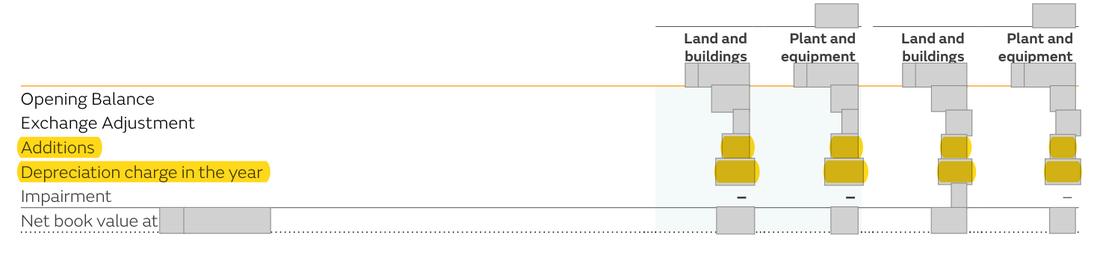
Note 7 analyses right-of-use assets for 2024 only: opening balance, additions, depreciation by class and closing book value. No 2023 column is given, so the 2023 additions and the 2023 depreciation by class of asset appear nowhere in the report. The 2025 report adds the comparative column, which shows the information was available.
The evidence, as filed
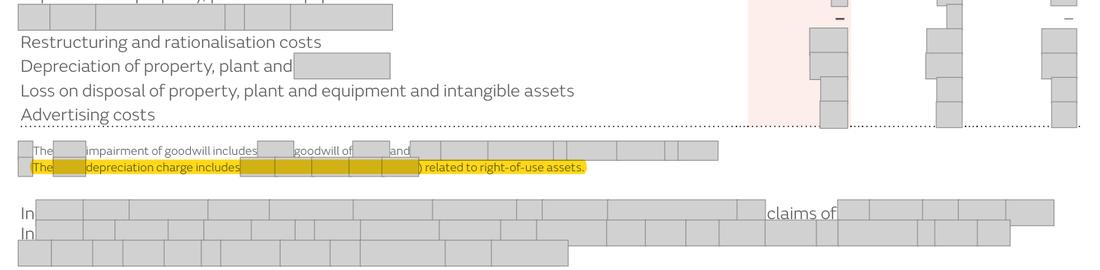
Further pages withheld to protect the company’s identity (one): Annual Report 2024, page 211. Their wording or layout could lead back to the company even with names and figures masked; the evidence list below records what each page shows.
Names, figures, dates, logos and any wording that could be searched back to the company are boxed out in grey; the point is highlighted in yellow.
What the report shows, and what the rule requires
| What the annual report shows | What the rule requires |
|---|---|
| What the annual report shows A single-year (2024) table: land and buildings opening [n], additions [n], depreciation ([n]), closing [n]; plant and equipment opening [n], additions [n], depreciation ([n]), closing [n]. The only 2023 figure is total right-of-use depreciation of [amount] in Note 3. | What the rule requires The same table with a 2023 column (additions and depreciation by class of underlying asset), as IAS 1.38 requires for every amount reported for the current period and as the 2025 report now presents it. |
The rule
IFRS 16 Leases, paragraph 53(a) and (h)
Version relied on: UK-adopted international accounting standards (UK Endorsement Board), as in force for financial years beginning in or after January 2025
A lessee must disclose, among other amounts, depreciation on right-of-use assets by class of asset and the additions to right-of-use assets in the period.
IAS 1 Presentation of Financial Statements, paragraph 38
Version relied on: UK-adopted international accounting standards (UK Endorsement Board), as in force for financial years beginning in or after January 2025
Unless a standard says otherwise, every amount in the current-year accounts needs a prior-year comparative.
Why it applies here: IFRS 16.53 requires additions and depreciation by class for the reporting period, and IAS 1.38 requires the preceding period for all amounts reported, so the 2023 figures were required.
Why it matters
- Readers of the 2024 report cannot compare lease additions and the split of right-of-use depreciation with 2023.
- Already put right in the 2025 report; the action is to keep the comparative.
Readers cannot compare 2024 lease additions and the split of right-of-use depreciation with 2023 from the 2024 report.
Exposure
No fine. At most an FRC question; the 2025 report already presents the comparative, so the realistic consequence is none beyond noting it.
Our workings
the right-of-use table in Note 7 is headed 2024 and has no comparative. The report gives the 2023 total depreciation on right-of-use assets ([amount]) in a footnote to Note 3, and the 2023 closing balances by class can be read from the 2024 opening balances ([n] and [n]), but the 2023 additions and the 2023 depreciation by class are not given anywhere.
2024 additions were [n] + [n] = [n] and depreciation [n] + [n] = [n], which agrees to the Note 3 footnote.
The 2025 report presents the table with both years.
| Item | 2024 ([wording masked]) | 2023 |
|---|---|---|
| Additions to right-of-use assets | [n] + [n] = [n] | Not given |
| Depreciation of right-of-use assets | [n] + [n] = [n] | [n] in total only (Note 3 footnote); no split by class |
| Closing carrying amount | [n] + [n] = [n] | [n] + [n] = [n] (2024 opening balances) |
Management’s best defence, and our reply
The company would say the amounts are small against total assets of over [amount] and that the 2023 total right-of-use depreciation and the 2023 closing balances by class can already be read from Note 3 and the 2024 opening balances. It would add that what is left out, the 2023 additions and the class split of 2023 depreciation, is not information on which a reader would act, so IAS 1.31 materiality allows it to be dropped.
The fix
- Present the right-of-use table with a comparative column for the preceding year (as the 2025 report does).
Evidence relied on
| # | What it shows | Type | Where |
|---|---|---|---|
| 1 | The table is headed 2024 only; opening balances by class equal the 2023 closing amounts | Document | Annual Report 2024, page 211 |
| 2 | 2024 additions by class; no 2023 figure beside them | Document | Annual Report 2024, page 211 |
| 3 | 2024 depreciation by class; no 2023 figure beside it | Document | Annual Report 2024, page 211 |
| 4 | Closing carrying amount by class at [date] | Document | Annual Report 2024, page 211 |
| 5 | The only 2023 right-of-use figure in the report: total depreciation, not by class | Document | Annual Report 2024, page 204 |
| 6 | The 2025 report presents the table for 2025 and 2024 | Document | Annual Report 2025, page 229 |
Absence check
- Document
- Annual Report 2024
- Where it would appear
- Information about the Group
- What is missing
- a 2023 column (additions and depreciation by class of underlying asset) in the right-of-use asset table
- Pages looked at
- p.204 (Note 3), 212-213 (Note 7), 223 and 245-246 (net debt and lease liabilities), [n] (alternative performance measures)
- Result
- 'right-of-use' hits p.159 (remuneration measure definition), [n] (total right-of-use depreciation for 2024, 2023 and 2022, not by class and with no additions), [n] (accounting policy), [n] (the [n]-only table) and [n] (total right-of-use assets in the return on invested capital reconciliation, [n] / [n] / [n]); 'right of use' has no hit; 'IFRS 16' hits p.159, [n] and [n] (lease liability movements in net debt, not right-of-use additions); 'Depreciation charge in the year' hits only the 2024 table on p.211; 'leased assets' hits only the policy on p.210. None gives the 2023 additions or the 2023 depreciation by class.
Prepared by Pramanex from the company’s published annual reports, without the company’s involvement, to show how an annual report review reads. The company is not named, and nothing on this page is a statement about any identifiable company. Observations are not an audit, review or other assurance engagement, and not legal advice. A regulator-style question is a question, not a conclusion.
Want this on your own annual report, before it is published?
Start with three free findings on your latest published annual report, or talk to us about a fixed-fee pre-publication review.
Your annual report will be in draft before the year-end audit.
Have it read before it is published.
Under NDA, with our reviewer on your insider list under UK MAR.